
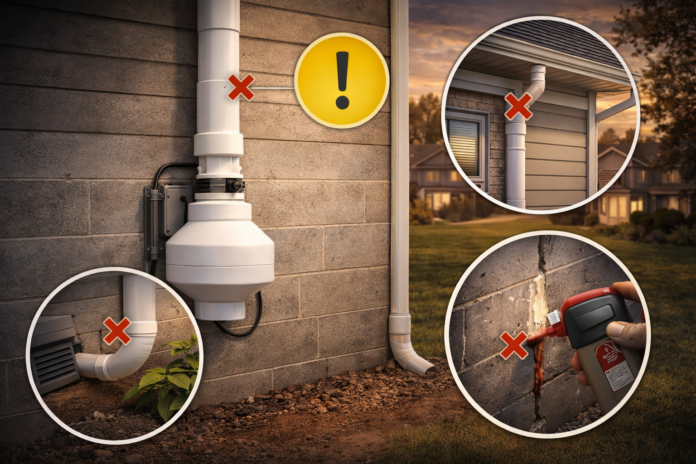
Radon Mitigation Mistakes: The Most Common Problems and How to Avoid Them
Radon mitigation is one of the most effective home safety upgrades you can make when radon levels are elevated. The frustrating part is that many “failed” mitigation projects are not failures of radon science. They are failures of process. The wrong system type for the foundation, poor installation details, skipped verification testing, or a lack of long-term maintenance can leave homeowners with higher radon than expected, confusing readings, or a system that quietly stops working.
This article breaks down the most common radon mitigation mistakes in plain English. For each mistake, you will learn why it matters, what it looks like in a real home, and what to do instead. This is written for homeowners, buyers, and sellers who want mitigation done correctly the first time.
Reminder on thresholds: EPA recommends fixing the home if radon is 4.0 pCi/L or higher, and also recommends considering action between 2.0 and 4.0 pCi/L. EPA action level guidance.
Table of Contents
- Mistake 1: Treating sealing cracks as the primary fix
- Mistake 2: Hiring the wrong contractor or skipping credentials
- Mistake 3: Choosing the wrong mitigation approach for the foundation
- Mistake 4: Bad fan placement that increases risk or noise
- Mistake 5: Poor discharge location and unsafe exhaust routing
- Mistake 6: Skipping post-mitigation testing
- Mistake 7: Assuming the pressure gauge measures radon
- Mistake 8: Turning the fan off or not running it continuously
- Mistake 9: Ignoring system maintenance and retesting
- Mistake 10: Not retesting after renovations or changing how you use the home
- Mistake 11: Treating a borderline result as “problem solved”
- Mistake 12: Letting documentation and verification get sloppy during a home sale
- Quick checklist: how to avoid most mitigation mistakes
- Sources
Mistake 1: Treating sealing cracks as the primary fix
Sealing cracks feels like the obvious solution. Radon comes from the soil, cracks are openings to the soil, so sealing should solve it. The issue is that radon entry pathways are usually more complex than the cracks you can see. A home can pull soil gas through tiny gaps at the slab edge, plumbing penetrations, sump pits, floor drains, hollow block walls, and hidden openings behind finished walls.
EPA’s Consumer’s Guide to Radon Reduction is direct on this point. Sealing alone has not been shown to lower radon levels significantly or consistently, and sealing is typically used along with other mitigation methods. EPA Consumer’s Guide to Radon Reduction (PDF).
What to do instead: Treat sealing as a supporting step. If radon is elevated, the reliable path is usually a proven mitigation approach such as active soil depressurization for many slab and basement homes. Sealing can help system efficiency and comfort, but it is rarely the main solution when radon is truly high. EPA Consumer’s Guide (PDF).
Mistake 2: Hiring the wrong contractor or skipping credentials
Radon mitigation looks simple from the outside. A pipe, a fan, a vent. That visual simplicity is exactly why homeowners sometimes hire a general contractor, handyman, or HVAC company that does not specialize in radon. The result is often an installation that “works” mechanically but performs poorly, creates unnecessary noise, or does not follow recognized safety and placement practices.
EPA recommends using qualified radon service providers and points consumers to national proficiency programs, including NRPP and NRSB, for finding credentialed professionals. EPA: find a qualified radon provider. NRPP provides a public search tool for certified professionals. NRPP: Find a radon professional.
What to do instead: Choose a contractor who does radon mitigation routinely, understands local requirements, and follows recognized standards of practice. EPA references ANSI/AARST radon standards as important resources for professional practice. EPA radon standards of practice and AARST standards library.
Mistake 3: Choosing the wrong mitigation approach for the foundation
Mitigation is not one-size-fits-all. A home with a basement slab, a home on a slab-on-grade foundation, and a home with a crawlspace may need different approaches. The mistake is assuming any fan-and-pipe configuration will work the same way everywhere.
EPA’s Consumer’s Guide to Radon Reduction outlines multiple mitigation techniques and emphasizes selecting an appropriate method for the home. The reason is simple: the system has to create the right pressure and airflow conditions in the right place to reduce radon entry. EPA Consumer’s Guide (PDF).
What this looks like in real homes: A crawlspace home may need a sub-membrane depressurization approach with proper sealing of the crawlspace membrane. A basement home may need sub-slab suction. A home with multiple foundation sections may need multiple suction points or a design that acknowledges the mixed layout. When the system design does not match the foundation, you can end up with a fan that runs constantly but does not reduce radon enough.
What to do instead: Ask the contractor to explain why the proposed method fits your foundation type and what they will do to verify it worked. If the explanation is vague, that is often a warning sign. EPA’s guidance is built around selecting the right method and verifying results. EPA Consumer’s Guide (PDF).
Mistake 4: Bad fan placement that increases risk or noise
Radon fans are designed to run continuously. Placement matters for safety, performance, and comfort. A common mistake is installing a fan inside the conditioned living space or placing it in a location that makes the system loud inside the home.
From a homeowner standpoint, noise is often the first thing that triggers regret. Even if the system reduces radon, a vibrating wall next to a bedroom creates a problem that homeowners may try to “solve” by turning the fan off. That leads directly to another major mistake discussed later.
What to do instead: Work with a qualified mitigator who understands placement best practices and has solved noise issues before. If you already have a noisy fan, the solution is often improved vibration isolation, better mounting, or in some cases a fan replacement, rather than living with it or cycling the fan on and off. EPA also notes that fans may last five years or more and may eventually need replacement, which can be part of long-term planning. EPA: system maintenance and fan lifespan.
Mistake 5: Poor discharge location and unsafe exhaust routing
Mitigation systems do not make radon disappear. They redirect it. That is why exhaust routing matters. Discharging in the wrong place can create unnecessary concern and, in extreme cases, can lead to re-entrainment, where exhausted radon is pulled back into the building through openings.
Homeowners sometimes push contractors to route pipes in the “most hidden” way possible, even if it means awkward terminations near windows, decks, or frequently used outdoor areas. This often backfires. You may end up with an annoying “whoosh” sound on a patio, or a discharge point that creates uncomfortable questions during a home sale.
What to do instead: Treat discharge routing as a functional safety choice, not a cosmetic afterthought. A qualified mitigator should be able to route the discharge to a suitable location while keeping the system efficient and minimizing noise. Standards of practice exist for radon mitigation work and can help frame what “good practice” looks like. EPA: radon standards of practice and AARST standards library.
Mistake 6: Skipping post-mitigation testing
This is the most damaging mistake because it leaves you with a story instead of a verified result. Homeowners sometimes assume that installing a mitigation system automatically means the home is now safe. It does not. The only way to know whether mitigation reduced your radon level is to test after installation.
EPA’s Consumer’s Guide to Radon Reduction emphasizes that you should test after mitigation to ensure the system is lowering radon levels. EPA Consumer’s Guide (PDF).
Why this matters: Some systems reduce radon dramatically. Some reduce it partially. Some underperform because the home needs a different suction strategy, an additional suction point, or better sealing of key entry routes like a sump. Without post-mitigation testing, you do not know which category you are in.
What to do instead: Build verification into your plan from the start. Ask the contractor what kind of post-mitigation test they recommend, when it should be performed, and what result you should expect. Use EPA’s action level framework to interpret the number. EPA action level guidance.
Mistake 7: Assuming the pressure gauge measures radon
Many systems include a simple pressure gauge, often a U-tube manometer. Homeowners sometimes think this gauge is a radon meter. It is not. The gauge indicates whether the fan is creating suction in the pipe. It does not tell you the radon concentration in the home.
The most common pattern is this: the gauge looks “fine,” so the homeowner assumes radon is fine, even if they have not retested in years. Meanwhile, home changes, fan wear, or system leaks can change actual radon levels.
What to do instead: Use the gauge as a basic operational indicator and use testing as the verification tool. EPA recommends looking at your warning device regularly and retesting periodically to ensure levels remain low. EPA: checking system operation and retesting.
Mistake 8: Turning the fan off or not running it continuously
Radon mitigation fans are intended to run continuously. The system is not designed for “only when we remember” operation. Homeowners sometimes turn the fan off to save electricity, reduce noise, or because they believe the house is “fixed now.” This can cause radon levels to rise again, sometimes quickly.
The deeper issue is that turning the fan off often happens because a system is annoying. It is loud, it vibrates, or the pipe routing bothers the homeowner. Those are installation and design problems that should be solved directly. Turning the fan off is the wrong workaround.
What to do instead: If the fan is too loud, solve the noise problem, do not cycle the fan. If you are concerned about cost, ask about the fan’s power consumption and focus on verified radon reduction as the priority. If you want peace of mind, retest after mitigation and retest periodically afterward. EPA advises that mitigation systems need occasional maintenance and recommends retesting at least every two years to ensure radon stays low. EPA: system maintenance and retesting.
Mistake 9: Ignoring system maintenance and retesting
Many homeowners treat mitigation as a one-time project. In reality, it is more like a furnace. It runs continuously and needs occasional attention. Fans wear out. Tubing can become disconnected. Power outages can affect devices. Home changes can alter airflow and pressure dynamics.
EPA explicitly notes that radon reduction systems need occasional maintenance, that fans may last for five years or more, and that it is a good idea to retest your home at least every two years to be sure radon levels remain low. EPA also provides a typical fan replacement cost range of about $200 to $350 including parts and labor. EPA: maintenance, fan lifespan, replacement cost, retesting.
What to do instead: Make a simple habit: check the system indicator occasionally and retest on a schedule. If the system has an alarm, treat it as a safety device, not as a decoration. If you replace a fan, follow up with testing so you know performance is restored.
Mistake 10: Not retesting after renovations or changing how you use the home
Even if your mitigation system is working, the home can change. Finishing a basement increases time spent at the lowest level. Adding a bathroom fan changes pressure. Replacing windows changes ventilation. Adding a new HVAC return can alter airflow patterns. These changes can affect radon levels and exposure, even when the mitigation system is still operating.
EPA provides guidance on retesting and encourages retesting when conditions change, including changes in the home that could affect radon entry or the amount of time people spend on lower levels. EPA: how often to test or retest.
What to do instead: Treat retesting as part of major home changes. If you finish a basement or move a bedroom to a lower level, retest. If you do major HVAC work, retest. You are not being paranoid. You are being procedural.
Mistake 11: Treating a borderline result as “problem solved”
Some mitigation projects reduce radon but do not reduce it as much as homeowners expect. This is where misunderstanding EPA guidance can lead to complacency. EPA recommends fixing at 4.0 pCi/L or higher and also recommends considering action between 2.0 and 4.0 pCi/L. EPA action level guidance.
If your post-mitigation result ends up near 3.5 pCi/L, some homeowners stop thinking about it because it is below 4.0. Others feel disappointed because they expected a drop to near outdoor levels. EPA notes in its reduction guidance that with today’s technology, radon levels in most homes can be reduced to 2 pCi/L or below. EPA Consumer’s Guide (PDF).
What to do instead: If you are still in the 2 to 4 pCi/L range after mitigation and you want further reduction, discuss system optimization with a qualified mitigator. Sometimes a second suction point, better sealing of key entry routes, or a fan adjustment can improve performance. The correct next step is guided by measurement, not guesswork.
Mistake 12: Letting documentation and verification get sloppy during a home sale
Mitigation mistakes become more expensive during a home sale because time pressure magnifies every uncertainty. A buyer sees a mitigation pipe and asks, “Does it work?” A seller says, “It should.” That is not enough. In a transaction, you want documentation and a recent test result.
EPA’s Home Buyer’s and Seller’s Guide to Radon is designed for transaction context and includes a radon testing checklist for reliable results and fewer disputes. EPA Home Buyer’s and Seller’s Guide (PDF).
What to do instead: If you are selling, keep a simple “radon packet” ready: installation invoice, any warranty information, and post-mitigation test results. If you are buying, do not treat the presence of a system as proof of current performance. Confirm with a test performed under appropriate conditions during the inspection window. EPA also points consumers to qualified provider searches if a new test or service is needed. EPA: find a qualified provider.
Quick checklist: how to avoid most mitigation mistakes
If you want a simple process that prevents most problems, use this checklist as your baseline.
Before installation: Confirm the contractor is qualified and can explain why the proposed method fits your foundation type. Confirm that post-mitigation testing is part of the plan. Use EPA guidance and recognized standards as your reference points. EPA Consumer’s Guide (PDF) and EPA standards of practice.
After installation: Test to verify the result. Do not rely on the pressure gauge as a radon measurement tool. EPA Consumer’s Guide (PDF).
Long-term: Check system indicators occasionally and retest periodically. EPA suggests retesting at least every two years and notes that fan replacement is a normal maintenance event over time. EPA: system maintenance and retesting.
After changes: Retest after major renovations or if the lowest level becomes more lived-in than before. EPA retesting guidance.
Sources
- EPA: Consumer’s Guide to Radon Reduction, How to Fix Your Home (PDF)
- EPA: How do I know if my radon mitigation system is working properly?
- EPA: How often should I test or retest my home for radon?
- EPA: What is EPA’s action level for radon and what does it mean?
- EPA: How can you find a qualified radon service provider in your area?
- NRPP: Find a Radon Mitigation or Measurement Professional
- EPA: Radon Standards of Practice (ANSI/AARST references)
- AARST: Radon Standards Library
- EPA: Home Buyer’s and Seller’s Guide to Radon (PDF)