
Active Soil Depressurization: How the Most Common Radon Mitigation System Works
If you spend enough time researching radon mitigation, you will see one term come up again and again: Active Soil Depressurization, often shortened to ASD. There is a good reason for that. In residential radon mitigation, ASD is the method most often used because it is effective, practical, and adaptable to a wide range of homes. If you picture a typical radon mitigation system with a vent pipe running up through the house and a fan mounted somewhere along that pipe, you are usually looking at some form of active soil depressurization.
For homeowners, the concept can sound more technical than it really is. The goal is straightforward. Instead of allowing radon-laden soil gas to seep into the house through cracks, joints, sump openings, crawl spaces, or other gaps, an ASD system pulls that gas from beneath the home and vents it safely above the roofline. In other words, it tries to intercept the radon before it has a chance to enter the living space.
This is why ASD matters so much in the radon world. It is not a fringe technology or a niche add-on. It is the core strategy behind most successful radon mitigation systems in existing homes. EPA, CDC, and radon program resources all point to soil depressurization, especially subslab depressurization, as the most commonly used and one of the most effective ways to reduce indoor radon levels. If you understand ASD, you understand the foundation of modern radon mitigation.
Table of Contents
- What Is Active Soil Depressurization?
- How Active Soil Depressurization Works
- The Main Parts of an ASD System
- Common Types of Active Soil Depressurization
- Why ASD Is So Effective
- Where ASD Works Best
- What Installation Usually Involves
- What ASD Can and Cannot Do
- What Happens After Installation
- The Bottom Line
- Sources
What Is Active Soil Depressurization?
Active Soil Depressurization is a radon reduction method that uses a fan to create lower air pressure beneath a home than the air pressure inside the home. That pressure difference is the key. When the pressure under the slab or membrane is lower than the pressure inside the house, soil gas is less likely to move inward through openings in the foundation. Instead, the system pulls the gas into a pipe and sends it outside.
The word active matters here. It means the system uses a powered fan. This distinguishes it from passive approaches that rely only on natural air movement or stack effect. In most existing homes with elevated radon, the active version is the more dependable approach because the fan creates a constant suction effect beneath the house.
Homeowners will also see related phrases like subslab depressurization, sub-slab suction, and soil depressurization system. These terms overlap heavily. In basement and slab-on-grade homes, active subslab suction is one of the most common forms of ASD. In crawl spaces, the concept may shift into submembrane depressurization, but the underlying idea is still the same: use suction to control soil gas before it enters the home.
How Active Soil Depressurization Works
Radon comes from the natural decay of uranium and radium in soil and rock beneath the home. As that radon forms, it can move upward through soil pores and foundation openings. Houses often create a slight vacuum relative to the soil below them, especially during heating and cooling cycles, and that pressure difference can draw radon inside.
ASD changes that pressure relationship. A contractor creates one or more suction points that connect the vent pipe system to the soil or aggregate beneath the foundation. A radon fan then pulls air from beneath the slab, from a drain tile path, from a sump pit, from block wall cavities, or from beneath a crawl space membrane, depending on the home’s construction. The collected gas moves through the pipe and is discharged safely outdoors above the house.
What makes this effective is that ASD is not trying to capture radon after it spreads through the house. It is addressing the problem at the entry point. The system works below the occupied space, reducing the amount of radon that can get indoors in the first place. That is a much more reliable strategy than trying to dilute indoor radon after it has already entered.
The Main Parts of an ASD System
Although every installation is a little different, most ASD systems have a few standard parts. The first is the suction point. This is where the system connects to the area beneath the home. In many basement homes, that means a hole is drilled through the slab and a small pit is excavated underneath to create a good pressure field.
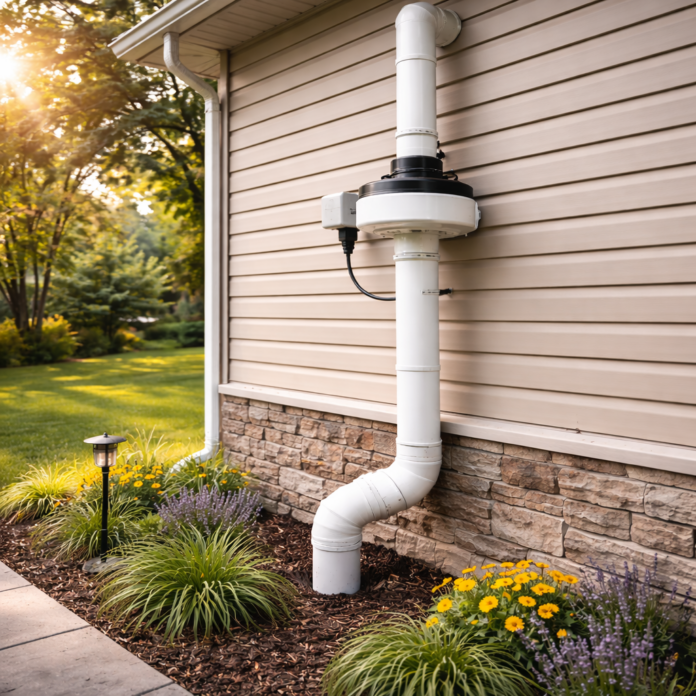
The second major component is the PVC vent pipe. This pipe carries the radon-laden soil gas from beneath the home to the outside. Depending on the layout of the house, the pipe may run through a garage, utility room, closet, basement corner, attic, or along an exterior wall. The best path depends on both performance and appearance.
The third critical part is the fan. This is what makes the system active. The fan creates the suction that lowers the pressure beneath the slab or membrane. In most properly installed systems, the fan is not placed inside a normal living area. It is usually located in an attic, garage, or outside the conditioned space so that any pipe leak is less likely to release radon into occupied rooms.
Many systems also include a manometer, usually a simple U-tube gauge mounted on the pipe. This helps homeowners confirm that the fan is operating. If the manometer levels change from their normal pattern, it can suggest a problem with suction or fan operation. A good system may also involve sealing certain cracks or openings, though sealing alone is not usually enough to solve a radon problem by itself.
Common Types of Active Soil Depressurization
When homeowners hear ASD, they often imagine a single standard design. In reality, ASD is more of a family of related approaches. The exact type depends on the foundation and how the house was built.
Subslab depressurization is the most familiar version. This is common in homes with basements or slab-on-grade foundations. A suction point is created through the concrete slab, and the fan draws soil gas from the material below the slab.
Drain-tile suction is another variation. If the home has a perimeter drain tile system, that pathway can sometimes be used to move suction more effectively around the foundation. In some houses, this improves pressure communication and radon reduction performance.
Sump-hole suction may be used when there is a sump pit that connects to the subslab area. With the proper airtight lid and setup, the sump can become part of the mitigation system rather than just a water-management feature.
Block-wall suction may be useful in homes with hollow block foundation walls. Radon and soil gas can move through those wall cavities, so reducing pressure there may be important in addition to or instead of subslab suction.
Submembrane depressurization is common in crawl spaces. In this method, a durable membrane is placed over exposed earth, and the system draws gas from beneath that membrane. While technically distinct in configuration, it follows the same ASD principle of creating lower pressure beneath the barrier than in the occupied space above.
Why ASD Is So Effective
The main reason ASD works so well is that it addresses the pressure dynamics that allow radon to enter a building. Radon entry is not just about cracks existing in the slab. It is about air movement. If soil gas is being pulled toward the home, radon can come with it. ASD flips that equation by making the subslab or submembrane zone the lower-pressure area instead.
This is also why ASD often performs better than simpler approaches like sealing alone or general basement ventilation. Sealing can help improve efficiency, but most foundations have too many tiny hidden openings for sealing by itself to be a dependable long-term radon solution. Ventilation can sometimes reduce radon in limited situations, but it is often less predictable and can create energy penalties or comfort issues. ASD is more direct and more targeted.
Another reason ASD is widely used is that it can be adapted to different homes. Some houses need only one suction point. Others need multiple suction points, a different fan strength, or special handling for block walls or crawl spaces. A qualified radon contractor can adjust the design to match the structure rather than forcing one rigid template onto every house.
Where ASD Works Best
ASD is especially common in homes with basements and slab-on-grade foundations. EPA guidance identifies active subslab suction as the most common and usually the most reliable radon reduction method in these types of homes. If the slab rests over gravel or other material that allows good air movement, ASD can be especially effective because suction can spread more easily beneath the floor.
Crawl spaces can also be good candidates, though the design usually shifts toward submembrane depressurization. In those homes, the contractor typically covers the soil with a sealed membrane and draws gas from beneath it. This approach can be highly effective when designed correctly, particularly in crawl spaces that are otherwise major radon entry zones.
That said, no two homes are exactly alike. Soil conditions, foundation design, slab thickness, drain tile layout, sump configuration, and even hidden construction details can affect how easily suction moves beneath the house. This is why professional design matters. ASD is a proven concept, but good results depend on matching the system design to the actual building.
What Installation Usually Involves
For many homeowners, the idea of radon mitigation sounds like a major reconstruction project. In most cases, it is not. A standard ASD installation is usually much less disruptive than people expect. The contractor begins by evaluating the home, the foundation type, and likely radon entry pathways. They then choose the pipe route, fan location, and suction strategy.
In a typical basement installation, one or more holes are drilled through the slab and a suction pit is created beneath. PVC piping is installed from that point upward to the fan and then to the discharge point above the house. Cracks, sumps, or other openings may be sealed to improve system performance. A manometer is installed so the homeowner can visually confirm suction.
The design challenge is often less about the concept and more about the path. Contractors try to balance performance, noise, appearance, and practicality. Some systems are routed in closets or utility chases to minimize visual impact. Others run along the outside of the house. The best solution depends on the layout and the homeowner’s preferences, but performance should always come first.
Once the system is running, the home should be retested to confirm radon reduction. Installation is not the finish line by itself. The goal is not simply to have a fan and a pipe. The goal is to verify that the indoor radon level has actually been lowered.
What ASD Can and Cannot Do
ASD is highly effective, but it is not magic. It cannot guarantee the exact same result in every home, and it does not eliminate the need for post-installation testing. A properly designed system can reduce radon dramatically, but the actual result depends on the home, the foundation, and the final system design.
It is also important to understand what ASD is not meant to do. It is not a general air purifier. It is not a substitute for fixing major moisture problems or structural defects, though some EPA materials note that subslab depressurization may also help reduce moisture and other soil gases in some cases. The main job of ASD is radon control.
Homeowners should also know that sealing is usually a supporting step, not the primary solution. Sealing cracks and openings can improve ASD efficiency, but by itself it rarely provides a reliable long-term fix for elevated radon. This is one of the most common misconceptions in homeowner radon discussions.
What Happens After Installation
After an ASD system is installed, the first major step is retesting. This confirms whether the system actually reduced radon to an acceptable level. EPA and CDC both emphasize that follow-up testing matters after mitigation. A system that looks professionally installed still needs to prove itself with a measurement result.
Homeowners should also check the manometer periodically and understand what normal operation looks like. The fan typically runs continuously, so the system should not be treated like a seasonal appliance that gets shut off when convenient. If the fan stops, suction stops, and radon can rise again.
Long term, ASD systems are usually fairly straightforward to live with. They may produce some operating noise depending on the layout and fan location, and they use electricity, but they are designed for continuous operation. The most important thing is not to ignore the system once it is installed. Like any mechanical system, it should be observed, understood, and retested when appropriate.
The Bottom Line
Active Soil Depressurization is the central workhorse of residential radon mitigation. It works by using a fan to create lower pressure beneath the home than inside the home, which helps keep radon-laden soil gas from entering the living space. In basement and slab-on-grade homes, this often takes the form of subslab depressurization. In crawl spaces, it may involve submembrane depressurization. The details vary, but the principle stays the same.
For homeowners, the biggest takeaway is that ASD is not an obscure or experimental solution. It is the standard approach because it works. EPA, CDC, and radon program guidance all point back to soil depressurization as the primary method used to reduce indoor radon in many homes. If your home has elevated radon and needs mitigation, there is a good chance ASD will be at the center of the solution.
So if you see a radon contractor recommend active soil depressurization, that is not a red flag or a mysterious upsell. It is usually the contractor pointing toward the method most commonly relied upon to solve the problem at its source: the soil beneath your home.
Sources
- U.S. Environmental Protection Agency: Consumer’s Guide to Radon Reduction
- Centers for Disease Control and Prevention: Reducing Radon Levels in Your Home
- ATSDR / CDC: Clinician Brief on Radon
- ATSDR / CDC: Radon Public Health Statement
- National Radon Program Services: Intro to Mitigation
- National Radon Program Services: Reducing Radon in Your Home
- U.S. Environmental Protection Agency: Radon Standards of Practice
- U.S. Environmental Protection Agency: Building Radon Out