
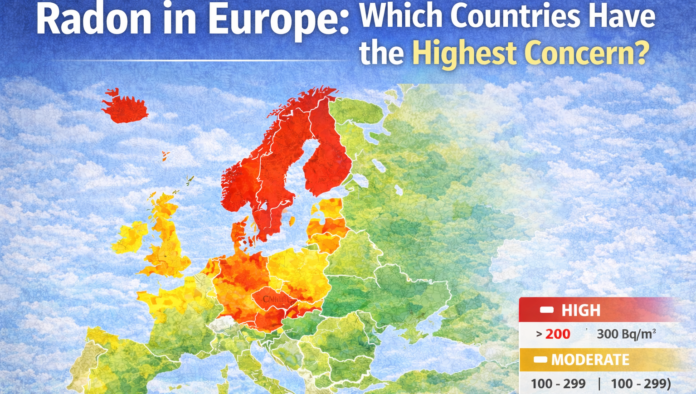
Radon in Europe: Which Countries Have the Highest Concern?
Radon is a Europe-wide issue, but it is not spread evenly across the continent. Some countries have long been known for high indoor radon levels, large radon-prone areas, or unusually strong national radon programs because the problem is so established. Others may have lower national averages but still contain serious local hot spots. That makes this topic more complicated than a simple top-10 list.
In fact, that is the first point worth making clearly. There is no single official European scoreboard that ranks every country from worst to best for radon. The European Commission Joint Research Centre maps indoor radon by grid cell, not by a neat country leaderboard. The European Environment Agency also frames radon as a geographically patterned environmental health issue tied closely to geology, building characteristics, and smoking risk, not as a simple national competition.
Still, if you step back and ask which European countries create the most consistent official concern, a few names keep appearing. The strongest standouts are usually the Nordic high-radon countries, especially Finland, Sweden, and Norway, along with the Czech Republic. Then there are countries where the concern is not always about having the very highest average, but where the risk is so well established that national mapping, testing, and building policy are deeply built around it, especially Ireland, the United Kingdom, Austria, and Switzerland.
This article explains why. Rather than forcing a false ranking, it looks at where official European and national sources point to the highest concern, what kind of concern they mean, and what homeowners should take away from it. If you are trying to understand whether Europe has a few standout radon countries, the short answer is yes. But the deeper answer is that radon in Europe is often more regional than national, and the countries of greatest concern are usually the ones where high-radon geology, colder climates, tighter buildings, or large mapped priority areas come together.
Table of Contents
- Quick Answer
- Why This Is Hard to Rank Cleanly
- How Europe Actually Judges Radon Concern
- The Nordic Core: Finland, Sweden, and Norway
- The Czech Republic: One of Europe’s Most Established High-Radon Countries
- Ireland and the UK: Strong Concern Driven by Mapped Risk Areas
- Austria and Switzerland: The Alpine High-Concern Belt
- What About the Rest of Europe?
- What Homeowners in Europe Should Actually Do with This Information
- Final Thoughts
- Sources
Quick Answer
If you ask which European countries create the highest radon concern, the most consistent official standouts are Finland, Sweden, Norway, and the Czech Republic. Those countries are repeatedly associated with high indoor radon, extensive radon-prone geology, or a large share of homes above national action or reference levels. A second group of high-concern countries includes Ireland, the United Kingdom, Austria, and Switzerland, where official radon programs, maps, building rules, and public health messaging show that radon is taken very seriously and is a significant national issue.
But there is an important catch. There is no single official Europe-wide ranking, and concern is often more local than national. A country can have a modest national average and still contain important radon hot spots. Another country can have a high national average but still contain many homes with low radon. That is why the better question is not just, “Which countries are worst?” It is, “Which countries and regions are treated by official European and national sources as the places where radon needs the most attention?”
On that question, the answer is much clearer. The Nordic countries, especially Finland, Sweden, and Norway, form the strongest cluster of European concern. The Czech Republic is another major standout. Ireland and the UK are especially notable for strong mapping and housing-risk frameworks. Austria and Switzerland stand out because their own official sources describe them as heavily affected by geology and because they maintain substantial radon programs.
Why This Is Hard to Rank Cleanly
Radon is not like a national tax rate or a national speed limit. It does not stop at borders, and it does not behave consistently across a whole country. The European Indoor Radon Map does not rank countries one through forty. It maps average indoor concentrations across 10 km by 10 km grid cells. That is a better way to display radon because the problem is driven by geology and building conditions, which vary sharply from one region to another.
The EEA makes the same point in broader public-health language. High indoor concentrations tend to occur in granitic zones and in areas with certain types of rock. Climate and human factors also matter. Homes with tighter envelopes, lower air exchange, basements, or different construction practices can behave very differently even inside the same town. The WHO also stresses that adjacent buildings can have very different radon levels and that geology, entry routes, and ventilation all matter.
So when people ask which countries have the highest concern, they are really mixing together several different ideas. One meaning is highest national average. Another is largest share of homes above action levels. Another is where official authorities have built the strongest mapping and intervention systems. Another is where geology creates especially persistent radon-prone areas. These are related, but they are not identical.
That is why this article uses the word concern instead of pretending there is one final numeric ranking. Concern is broader and more useful. It includes national average exposure, housing stock above reference levels, strong official mapping, established radon action plans, and the degree to which public authorities treat radon as a major recurring issue rather than a minor one.
How Europe Actually Judges Radon Concern
Across Europe, concern about radon is usually judged through a mix of public health, mapping, and regulation. At the health level, the WHO describes radon as a major cause of lung cancer and notes that the share of lung cancers linked to radon depends partly on a country’s average radon level and smoking prevalence. The EEA says indoor radon is a major cause of lung cancer in Europe and estimates that around 19,000 lung cancer deaths in Europe in 2019 may have been due to residential indoor radon.
At the policy level, the European radon picture has become more structured because EU law now requires action. The EEA explains that the EU Basic Safety Standards Directive required Member States to establish national radon action plans, set indoor reference levels for dwellings and workplaces, and identify radon priority areas. The JRC’s atlas rationale chapter also notes that Member States must identify areas where a significant number of buildings are expected to exceed national reference levels.
At the map level, Europe now has a much better shared picture than it did years ago. The 2024 update of the European Indoor Radon Maps brings together ground-floor residential data supplied by national competent authorities. That means the European picture is not just theory. It is built from actual national datasets, harmonised into comparable grid maps.
At the homeowner level, concern becomes practical when countries define threshold systems. Some countries use a reference level of 300 Bq/m³ in homes. Others keep older or stricter action frameworks around 200 Bq/m³. The WHO recommends a national residential reference level of 100 Bq/m³ where possible, and says it should not exceed 300 Bq/m³ if country-specific conditions make 100 impractical. Europe is therefore not fully harmonised, but the broad shape is clear: countries with higher indoor levels, larger radon-prone areas, or large numbers of homes above 200 or 300 Bq/m³ generate more concern.
Using that framework, some countries stand out much more than others.
The Nordic Core: Finland, Sweden, and Norway
If you had to name the strongest high-concern cluster in Europe, the Nordic countries would be the first place to look, especially Finland, Sweden, and Norway. This is not just a casual reputation. A joint Nordic recommendation prepared by radiation authorities and experts from Sweden, Finland, Norway, and Denmark states that radon levels in Nordic dwellings, except for Iceland, are high, and that Finland, Norway, and Sweden are among the highest in the world. The same document says this makes it particularly important to identify dwellings with high radon concentrations and reduce them.
That Nordic framing matters because it comes from authorities in countries that have lived with radon policy for decades. It is not merely saying these countries have “some radon.” It is saying they belong in the world’s top tier of concern. The reasons are also clear. The Nordic document links the pattern to high uranium concentrations in bedrock and soil formations, combined with cold climate and often lower air exchange. In other words, geology and building conditions reinforce each other.
Finland is one of the clearest examples. The Finnish Radiation and Nuclear Safety Authority, STUK, says the average radon concentration in Finnish homes is about 94 Bq/m³. It also says radon in breathing air is usually the most significant source of radiation exposure for Finns. In Finland’s national radon action plan, STUK estimates that of roughly 2,000 lung cancer deaths each year in Finland, about 300 are related to radon exposure. That is an extraordinary number for a country of Finland’s size and one reason Finland belongs in any serious European radon discussion.
Finland also shows what high concern looks like in regulation. STUK says the reference level for indoor radon concentration in dwellings is 300 Bq/m³, while the reference level for the design and construction of new buildings is 200 Bq/m³. Finland’s testing protocols are also quite structured. Measurements are generally expected to last at least two months and are tied to seasonal conditions, reflecting how seriously long-term accuracy is treated.
Sweden is another major standout. The Swedish Radiation Safety Authority, SSM, estimates that radon in dwellings causes around 500 lung cancer cases per year in Sweden, most commonly among smokers. That alone signals a major public health burden. Sweden also has unusually specific published analysis on the housing stock itself. In a 2021 SSM report, the national average radon concentration in single-family houses was estimated at roughly 128 Bq/m³ for 2007/2008 and 136 Bq/m³ for 2008/2009, and the agency estimated that about 16% of Sweden’s single-family houses in 2021, around 330,000 homes, still had radon levels above 200 Bq/m³.
That is a huge figure. It shows why Sweden is not just “a country that has radon.” It is a country where a very large housing segment still exceeds the level that many countries would treat as a serious action point. Sweden also has its own special historical complication: parts of its building stock were affected by so-called blue concrete, which the 2021 SSM report still lists as one of the background factors associated with higher radon. So in Sweden, concern comes not only from geology but also from the interaction between soil, uranium in the ground, building materials, and housing age.
Norway belongs in the same cluster. The Norwegian Radiation and Nuclear Safety Authority, DSA, takes such a broad approach that it recommends radon measurements in all residential dwellings, not only homes in mapped risk areas. That is unusually strong language and tells you a lot about the Norwegian situation. DSA also says radon levels in homes should be as low as reasonably achievable and always under 200 Bq/m³, with mitigation measures implemented when levels above 100 Bq/m³ are measured.
Norway’s official health message is equally direct. DSA says radon in homes causes around 300 lung cancer deaths a year in Norway. A Nordic recommendation document and older Norwegian strategy material also show why concern is so persistent there: large numbers of homes above 200 Bq/m³, significant bedrock and soil contributions, and important radon input from drilled wells in solid rock in some areas.
Put simply, if someone asks which part of Europe is most consistently associated with high radon concern, the answer is the Nordic core. Finland, Sweden, and Norway are not just countries with local hot spots. They are countries whose own official sources treat radon as a large-scale, long-term national issue.
The Czech Republic: One of Europe’s Most Established High-Radon Countries
The Czech Republic is another country that stands out very strongly in Europe, and in some ways it is one of the continent’s classic radon cases. The Czech State Office for Nuclear Safety, SÚJB, states in its national radon action plan that due to its specific geological subsoil, the Czech Republic is one of the countries with higher levels of exposure to radon in the world. That is about as direct as an official statement gets.
The same Czech action plan says that, according to estimates from the National Radiation Protection Institute, more than 4.5% of the housing stock in the Czech Republic is overburdened with radon. It also notes that Czech legislation defines municipalities with increased radon risk and that in these areas the probability of exceeding the national radon reference level is higher than 30%. That is a striking threshold and shows that Czech radon policy is built around a mature, geographically targeted understanding of the problem.
What makes the Czech Republic especially notable is how long and how systematically it has worked on radon. The action plan refers to a long-developed system of radon maps, ongoing surveys, a national radon database, and radon-aware construction and reconstruction policy. In other words, Czech concern is not only about elevated geology. It is also about the fact that the country has been dealing with the consequences of that geology for a very long time and has built a detailed radon control framework around it.
That is why the Czech Republic belongs near the top of any Europe-focused radon discussion. It may not always get as much casual attention as the Nordic countries in English-language radon conversations, but official sources clearly show it is one of Europe’s most established high-radon countries.
Ireland and the UK: Strong Concern Driven by Mapped Risk Areas
Ireland and the United Kingdom are slightly different from the Nordic countries and the Czech Republic. Their importance in the European radon picture is not only about having the very highest national averages. It is also about how extensively radon has been mapped, integrated into home-buying and building frameworks, and treated as an everyday housing issue.
In Ireland, the Environmental Protection Agency, EPA, defines a High Radon Area as an area where it is predicted that more than 10% of homes will exceed the national reference level. The EPA also says the average radon level in Irish homes is about 77 Bq/m³. That average is not as high as the most affected Nordic countries, but it is still significant, and Ireland’s mapping framework makes clear that there are large areas where the probability of elevated homes is high enough to justify special public focus.
Ireland’s radon system is also notable because it is very homeowner-oriented. The EPA provides a national radon risk map, county-level results, buyer-and-seller guidance, workplace guidance, school guidance, and strong emphasis on testing. That kind of infrastructure usually exists only where radon is a well-established public health issue. Ireland therefore belongs in the high-concern conversation not only because of the numbers, but because of the depth of its official response.
The UK shows a similar pattern. UKHSA and UK Radon use the concept of radon Affected Areas. In UK policy, an affected area is essentially a place where there is enough probability of homes being above the action level that testing is formally recommended. UK guidance says that if a property is not in an affected area, there is less than a 1% chance of having a high level. That means the affected-area framework is built around places where the probability is at least meaningful enough to trigger public health action.
The UK also still uses a distinctive two-level approach for homes: an Action Level of 200 Bq/m³ and a Target Level of 100 Bq/m³. UK Radon says radon causes over 1,100 lung cancer deaths each year in the UK and publishes affected-area maps for the whole country. That combination of maps, transaction guidance, building regulation links, and public health messaging shows a country where radon is not treated as a rare scientific curiosity. It is treated as a recurring housing risk with clear geographic concentration.
So why are Ireland and the UK important in a European ranking of concern? Because both countries have built strong public systems around the assumption that where you live matters. They may not be identical to Finland or Sweden in raw average levels, but their official radon frameworks are among the most visible and developed in Europe.
Austria and Switzerland: The Alpine High-Concern Belt
Austria and Switzerland are especially important because they show how the Alpine part of Europe contributes to the continent’s radon risk picture. These are countries where the geology itself is repeatedly presented as a major reason for concern.
Austria’s official radon portal, radon.gv.at, states very directly that Austria has one of the highest radon levels in the world. The site says elevated indoor radon can occur anywhere in Austria, but also that there are areas where an above-average number of buildings have high radon levels. Based on more than 50,000 measurements, Austria has defined radon protection areas and radon precautionary areas, and its building framework requires preventive radon measures in new buildings in precautionary areas.
The Austrian site also says that around 500,000 people in Austria live in homes with radon concentrations above the reference value, and the Austrian federal ministry says radon causes around 10% of lung cancer cases in the country, or roughly 400 cases per year. Those are major numbers. Austria also uses a long household measurement period of about six months, which again reflects how seriously it treats seasonal variation and annual-average exposure.
Switzerland has a slightly different profile but clearly belongs in the same discussion. The Swiss Federal Office of Public Health, FOPH, says Switzerland is particularly affected by radon because of its geology. Its radon page says areas with elevated radon concentrations are mainly found in the Alps and the Jura, though high concentrations have also been found on the Central Plateau. Switzerland’s radon map is built around the probability of exceeding a national reference value of 300 Bq/m³ for buildings where people stay regularly for several hours a day.
Switzerland also keeps a long-term national action plan and has a mature legal and mapping system. Its official health messaging says radon is responsible for around 200 to 300 deaths per year in Switzerland and is second only to smoking as a leading cause of lung cancer. That is a very substantial burden for a relatively small country.
The reason Austria and Switzerland matter in this article is that they remind us the European radon story is not only northern. The Alpine and sub-Alpine parts of Europe also produce some of the continent’s strongest official concern. If you only looked at the Nordic countries, you would miss a major piece of the map.
What About the Rest of Europe?
The rest of Europe is not “safe” simply because it is not in the first group. The JRC map and the EEA both make clear that radon is strongly tied to geology, and that high concentrations are found in granitic zones and other susceptible rock areas across the continent. That means countries outside the core high-concern group can still contain important local problem areas.
This is especially important when people rely too much on national averages. A country can look moderate on paper and still contain municipalities, valleys, mountain belts, or building types where radon is a very real issue. The Czech system of risk municipalities, the Irish system of High Radon Areas, the UK system of Affected Areas, the Austrian radon protection areas, and the Swiss probability map are all built on the same basic truth: radon is patchy.
That is also why a simple Europe-wide “top countries” list can be misleading. It may help with broad awareness, but it can mislead homeowners into thinking their own country is either clearly bad or clearly irrelevant. In reality, the better approach is this: identify the countries with the strongest overall concern, then remember that many other European countries still contain local zones where radon testing is absolutely justified.
So the rest of Europe should not be dismissed. It should be understood more carefully. The real map of concern is a mix of countries with strong national radon profiles and countries with strong regional hot spots.
What Homeowners in Europe Should Actually Do with This Information
The most practical lesson from all of this is that country-level reputation is only a starting point. If you live in Finland, Sweden, Norway, the Czech Republic, Ireland, the UK, Austria, or Switzerland, you should assume radon deserves serious attention. These are not fringe radon countries. Their own official authorities treat radon as a substantial and recurring issue. But even then, the right next step is still not panic. It is testing.
The same applies elsewhere in Europe. If you live in a mountainous area, a granitic zone, an area with official radon maps, or a house with a basement or direct ground contact, your personal radon risk may matter more than your country’s headline average. The WHO stresses that adjacent buildings can vary significantly and that measurements should usually be long enough to estimate an annual average. In other words, maps are useful, but a real test result is better.
Another key point is that Europe does not treat radon as a problem only for existing homes. Official sources across Europe repeatedly connect radon to building codes, new construction, and renovation. The EEA, WHO, and many national authorities emphasize that radon prevention at the design stage is often cheaper and more effective than retrofitting later. That matters especially in countries where energy-efficient construction and tighter building envelopes can trap more radon if the sub-floor and ventilation details are not handled properly.
Smoking status also changes the picture. WHO and national authorities repeatedly warn that radon risk is much higher for smokers. So if someone lives in one of Europe’s higher-concern radon countries and also smokes, the urgency of measuring and, if needed, mitigating becomes much greater.
For homeowners, then, the practical ranking looks like this. First, know whether you live in a country or region with established official radon concern. Second, use national maps and address tools if available. Third, test the property using the national protocol. Fourth, if the result is high, reduce it using proven building measures rather than guesswork. That is how the countries with the strongest radon programs already approach the issue.
Final Thoughts
If you force the question into a short answer, the European countries with the strongest recurring radon concern are Finland, Sweden, Norway, and the Czech Republic, with Ireland, the UK, Austria, and Switzerland also standing out clearly in official mapping, regulation, or public-health attention. These are the countries that most consistently appear in official European and national sources as places where radon is not a minor side issue but a meaningful housing and health problem.
But the better answer is a little more careful. There is no perfect Europe-wide ranking because radon does not behave on national boundaries. It follows geology, building conditions, climate, and how people live indoors. That is why Europe’s official radon systems rely so heavily on maps, priority areas, and testing protocols rather than simplistic country labels.
So which countries have the highest concern? The Nordic trio, the Czech Republic, and several strongly mapped or geologically affected countries such as Ireland, the UK, Austria, and Switzerland belong near the top of the conversation. But the deeper lesson is that radon concern in Europe is best understood as a map, not a scoreboard. And for any homeowner, the only number that finally matters is the one measured in the home itself.
Sources
- World Health Organization: Radon and Health
- European Environment Agency: Radon
- European Commission JRC: European Indoor Radon Map
- European Commission JRC: European Indoor Radon Maps 2024
- European Atlas of Natural Radiation: Legal Basis and Requirements
- STUK: Radon in Finland
- STUK: National Action Plan to Prevent Radon Risks
- Swedish Radiation Safety Authority: Radon
- Swedish Radiation Safety Authority: Analysis of Radon Levels in Swedish Dwellings and Workplaces
- Norwegian Radiation and Nuclear Safety Authority: Radon Measurements in Residential Dwellings
- Norwegian Radiation and Nuclear Safety Authority: Radon and Health Risks
- Norwegian Radiation and Nuclear Safety Authority: Radon Mitigation Measures
- Recommendations for Radon in Dwellings in the Nordic Countries
- Czech State Office for Nuclear Safety: National Action Plan for Control of Public Exposure to Radon
- Ireland EPA: Radon
- Ireland EPA: Householders
- Ireland EPA: Radon Results by County
- UK Radon: UK Maps of Radon
- UK Radon: Action Level and Target Level
- UK Radon: The Risks to Your Health from Radon
- Austria Radon Portal: Where Does Radon Occur?
- Austria Radon Portal: How Can I Measure Radon?
- Austria Radon Portal: Legal Matters
- Austria Federal Ministry: General Information on Radon
- Swiss Federal Office of Public Health: What Is Radon?
- Swiss Federal Office of Public Health: Radon Map of Switzerland
- Swiss Federal Office of Public Health: Radon Action Plan 2021-2030
- Swiss Federal Office of Public Health: Legal Dispositions Concerning Radon