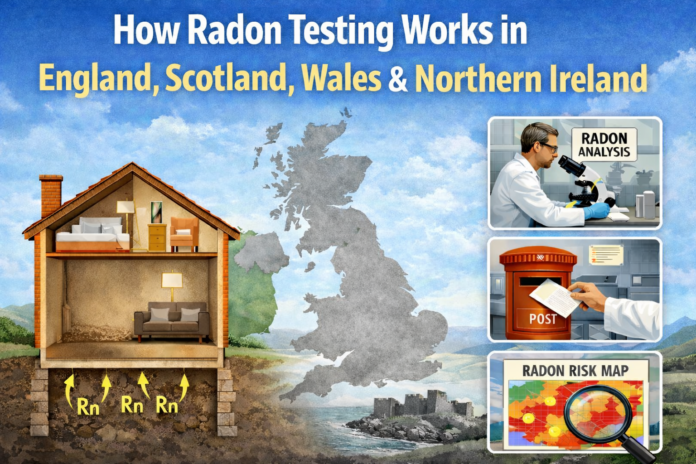
How Radon Testing Works in England, Scotland, Wales, and Northern Ireland
If you start researching radon testing in the UK, one question comes up quickly: does the process work the same way in England, Scotland, Wales, and Northern Ireland, or does each nation do it differently?
The short answer is that the core homeowner testing process is mostly the same across all four nations. The UKHSA and UKradon system provides the main framework for checking whether a property may be affected, ordering a household radon test, carrying out the standard three-month measurement, and comparing the result against the UK Action Level.
But that is not the full story.
Once you look more closely, there are also some real national differences around the edges. The official touchpoints are not always the same. The local agencies involved are not always the same. Building standards and housing frameworks are not always described the same way. Northern Ireland, in particular, has a stronger role for NIEA in mapping and homeowner enquiries. Wales has some especially useful landlord guidance that explains the testing basis in plain language. Scotland routes public-health radiation advice through UKHSA but has its own building standards language around radon probability areas. England leans most directly on the GOV.UK and UKradon pathway.
So the right way to think about it is this: the test itself is mostly UK-wide, but the surrounding local guidance and regulatory context vary by nation.
This article explains exactly how that works, what is shared across the UK, what is different in each nation, and what homeowners should actually do depending on where they live.
Table of Contents
- The short answer
- What is the same across all four nations?
- The basic UK-wide homeowner testing process
- How radon testing works in England
- How radon testing works in Scotland
- How radon testing works in Wales
- How radon testing works in Northern Ireland
- The biggest differences between the four nations
- What homeowners should actually do
- Common mistakes to avoid
- Bottom line for homeowners
- Sources
The short answer
For most ordinary householders, radon testing works very similarly in England, Scotland, Wales, and Northern Ireland.
Across the UK, the main homeowner route is usually the same:
- check whether the property is in a radon Affected Area,
- order or arrange a radon measurement,
- place detectors in the right rooms,
- leave them in place for about three months,
- return them for analysis,
- then compare the result against the UK radon Action Level.
The UKHSA and UKradon framework sits at the centre of that process. GOV.UK describes UKHSA as the UK’s primary expert on radon and directs the public to UKradon for maps, advice, and measurement services.
The biggest differences are not usually in the detectors or the length of the test. They are more often in the surrounding public information, building regulations, landlord rules, local agency contacts, and map presentation.
What is the same across all four nations?
The most important point to understand is that the core technical logic of homeowner radon testing is shared across the UK.
On the UKradon measuring page, UKHSA says the preferred domestic test uses two detectors, one in the living area and one in an occupied bedroom, over three months. UKHSA explains that the purpose of this is to average out short-term fluctuations and estimate actual exposure in the rooms people use most.
That basic method is not presented as an England-only process or a Wales-only process. It is the central UK homeowner measurement model.
The same page also says that occupied basements, defined there as those used for more than 50 hours per year, should be monitored regardless of mapped radon potential. Again, that is framed as general UK household advice, not as something limited to one nation.
The UK radon Action Level also remains the same across the system. UKHSA’s Action Level page says homes should be reduced if the annual average concentration is more than 200 Bq/m³, and that the Target Level is 100 Bq/m³.
So if you are asking whether the actual test kit, the test length, and the main result thresholds are shared across the UK, the answer is mostly yes.
The basic UK-wide homeowner testing process
Before separating the four nations, it helps to understand the shared UK homeowner process first.
Step 1: Check whether the property may be in a radon Affected Area.
Homeowners usually begin with the free UK radon map or the more property-specific address search. The map gives a broad indication of the probability of higher indoor radon. The address search gives a more specific estimate for an individual property.
Step 2: Decide whether to measure.
If the property is in an Affected Area, UKHSA recommends measuring. For properties with occupied basements, UKHSA recommends measurement regardless of mapped radon potential.
Step 3: Carry out the standard measurement.
UKHSA’s household test typically uses two detectors over about three months. One goes in a living area and one goes in an occupied bedroom.
Step 4: Return the detectors and receive the result.
UKHSA says the result will give the yearly average radon level in the home and explain whether it is above or below the Action Level.
Step 5: Act if necessary.
If the result is at or above 200 Bq/m³, UKradon says the level should be reduced. If the result is between 100 and 200 Bq/m³, action should still be considered, especially if a smoker or ex-smoker lives in the home.
That is the shared backbone. The next sections explain how each nation fits around that backbone.
How radon testing works in England
England is the part of the UK where the radon testing pathway feels most directly aligned with the core UKHSA and GOV.UK model.
On GOV.UK’s radon collection page, UKHSA is described as the UK’s primary expert on radon and radiation protection. That page sends homeowners directly to UKradon for health information, radon-affected-area maps, and UKHSA’s radon measurement services.
In practice, that means homeowners in England will usually do the following:
- check the property on UKradon,
- order a radon address search if needed,
- order a domestic measurement pack or use a validated lab,
- run the standard three-month test with two detectors,
- then decide whether to reduce the level based on the result.
England also fits neatly into the UK house-sale model described on UKradon’s house sales page. If the property is in a radon Affected Area, buyers are encouraged to ask whether the seller has already carried out a three-month radon test and to request the result if so.
So for England, the simplest description is this: the official route is largely GOV.UK to UKHSA to UKradon.
How radon testing works in Scotland
For homeowners in Scotland, the actual testing method is still largely the same as elsewhere in the UK, but the surrounding public-health and building-standards context feels a little different.
Public Health Scotland says that UKHSA has the remit for providing advice on public-health issues associated with radiation in Scotland, including radon gas. That is a useful line because it confirms that Scotland still relies on UKHSA for the specialist radon advice base rather than operating a completely separate national household testing system.
So if you are a Scottish homeowner wondering how to test, the answer is still mostly the familiar one: use UKradon for checking and measurement services.
Where Scotland stands out more clearly is in building standards. The Scottish Government’s domestic technical handbook explains that radon probability areas in Scotland have been designated by testing dwellings, and that areas where at least 1% of dwellings are likely to exceed 200 Bq/m³ are relevant to protective measures in construction.
That means the homeowner measurement process itself is not radically different, but the language around the construction and building-standards system is more distinctly Scottish.
For a Scottish homeowner, the practical answer is:
- use UKradon to check and measure,
- understand that Scottish building standards refer to radon probability areas,
- treat building work, extensions, or new construction with that framework in mind.
How radon testing works in Wales
Wales is another nation where the testing process itself is mostly shared, but the supporting official material adds some useful Welsh-specific context.
The Welsh Government’s page on radon in homes and buildings is very short but very clear. It says every building has radon, that some buildings in radon affected areas have higher levels, and that buildings in these areas should be tested. It then points homeowners to UKradon for more advice and maps.
That means the practical homeowner path in Wales is still fundamentally the UKradon path. Welsh householders are not being sent to a separate Welsh household detector programme.
Where Wales adds more detail is in housing and landlord guidance. On the Welsh Government’s fitness for human habitation guidance, the radon section explains that:
- the average level in UK homes is 20 Bq/m³,
- levels below 100 Bq/m³ remain relatively low risk and are not usually a cause for concern,
- radon levels in domestic properties should be reduced where the average is more than the Action Level of 200 Bq/m³.
Crucially, that same Welsh guidance also explains that the Action Level refers to the annual average concentration as measured using two detectors in a bedroom and living room over three months. That makes Wales one of the places where the technical measurement basis is stated especially clearly in an official housing context.
So for Welsh homeowners, the answer is:
- test through the same broad UKradon model as the rest of the UK,
- note that Welsh housing guidance explains the annual-average, two-detector, three-month basis particularly clearly.
How radon testing works in Northern Ireland
Northern Ireland is the part of the UK where the homeowner pathway feels most visibly different around the edges, even though the test itself still fits the wider UK model.
On the official nidirect radon page, Northern Ireland householders are told that the Northern Ireland Environment Agency, or NIEA, works with UKHSA to map radon levels in homes throughout Northern Ireland. The page says that if your home is in a coloured area of the map, it is recommended that you arrange for a radon test to be carried out, and it gives NIEA contact details for help reading the map or getting more advice.
That means Northern Ireland homeowners still live inside the broader UKHSA radon framework, but they have an extra local agency touchpoint that is much more visible than in England, Scotland, or Wales.
The same nidirect page also repeats the UK Action Level of 200 Bq/m³ and says that above this level householders are recommended to take action to cut radon levels. It also notes that new buildings, extensions, conversions, and refurbishments must be fitted with basic radon preventive measures in parts of Northern Ireland with a 1% or greater probability of exceeding the Action Level.
So for Northern Ireland, the practical model is:
- use the Northern Ireland official guidance and maps as your local entry point,
- recognise that NIEA is a visible part of the support structure,
- understand that the wider UKHSA radon framework and Action Level still apply.
The biggest differences between the four nations
Once you step back, the main cross-nation differences become easier to see.
- The testing method is mostly shared. Across all four nations, the main homeowner test is still built around UKHSA and UKradon, using two detectors over about three months to estimate annual average exposure.
- The local entry points differ. England leans most directly on GOV.UK and UKradon. Scotland relies on UKHSA for specialist radiation advice but wraps that inside Scottish public-health and building-standards systems. Wales points homeowners to UKradon but also explains radon more explicitly in housing guidance. Northern Ireland adds NIEA as a more visible local contact and map partner.
- Building-regulation language differs. Scotland uses its own radon probability area wording in building standards. Northern Ireland’s official guidance separately describes where basic preventive measures are required. England and Wales sit more directly under the UKradon and wider UK building-regulation discussion.
- Housing and landlord guidance is not equally detailed everywhere. Wales stands out for having especially clear landlord guidance that explains the Action Level and the testing basis in plain language. England and the wider UK rely more on UKradon’s landlord materials. Scotland and Northern Ireland do not foreground that same explanation in the exact same way for householders.
- Northern Ireland has the clearest additional local agency role. The official Northern Ireland guidance explicitly says NIEA works with UKHSA to map radon levels and tells householders to contact NIEA if they need help reading the map or advice.
What homeowners should actually do
For most people, the practical advice is simpler than the policy detail.
- If you live in England, start with UKradon or the GOV.UK radon collection.
- If you live in Scotland, use UKradon for the actual home-testing route, but keep Scottish building standards in mind if you are building, converting, or extending.
- If you live in Wales, use UKradon for the testing pathway, and read Welsh housing guidance if you are a landlord or want a more formal explanation of the Action Level basis.
- If you live in Northern Ireland, use the nidirect guidance and UKradon together, and contact NIEA if you need help with map interpretation or local advice.
No matter which nation you are in, the underlying homeowner process is still broadly the same:
- check whether the property may be affected,
- arrange the right measurement,
- carry out the test properly,
- act on the result if it is high.
Common mistakes to avoid
- Assuming each UK nation has a completely separate homeowner test kit system. For most householders, the core UKHSA and UKradon measurement model is still the main route across all four nations.
- Assuming there are no differences at all. There are differences, but they mostly live in the local support structure, housing law, and building standards rather than in the basic detector method.
- Using the map as if it were a direct home measurement. The map shows probability, not the actual radon level in your home.
- Ignoring basements. UKHSA says occupied basements should be monitored regardless of mapped radon potential.
- Thinking Northern Ireland follows a totally different Action Level. It does not. Northern Ireland’s official guidance still uses the UK Action Level of 200 Bq/m³, even though the local support route includes NIEA.
- Thinking Wales or Scotland must use different detector durations because they have different governments. For ordinary homeowner testing, the core three-month UKHSA/UKradon method remains central.
Bottom line for homeowners
Radon testing in England, Scotland, Wales, and Northern Ireland is more similar than different for ordinary homeowners.
The central UK household model is the same almost everywhere: check whether the property may be in an affected area, measure with two detectors over about three months, compare the result against the UK Action Level, and reduce the level if it is high.
The biggest differences are in the surrounding framework. England feels most directly GOV.UK and UKradon-led. Scotland uses the same specialist advice base but wraps it in Scottish public-health and building-standards language. Wales points to the same UKradon path but explains the testing basis particularly clearly in housing guidance. Northern Ireland adds a more visible role for NIEA alongside UKHSA.
So if you are a homeowner trying to figure out what to do, the best answer is not to overcomplicate the national differences. Start with the right official entry point for your nation, but expect the actual measurement method to look very similar across the UK.
Sources
- UKradon: Home
- UKradon: Measuring Radon
- UKradon: UK Maps of Radon
- UKradon: Order a Radon Address Search
- UKradon: Radon Action Level and Target Level
- GOV.UK: Radon
- Public Health Scotland: Environmental Public Health Overview
- Scottish Government: Building Standards Technical Handbook, Radon Gas
- GOV.WALES: Radon in Homes and Buildings
- GOV.WALES: Fitness of Homes for Human Habitation Guidance for Landlords
- nidirect: Radon Gas in Your Home