UK Radon Action Level Explained
If you read about radon in the UK for long enough, one number keeps appearing: 200 Bq/m³. That number is known as the UK Radon Action Level. But many homeowners still come away unsure what it actually means.
Does it mean anything below 200 is safe? Does it mean a result above 200 is an emergency? Is it just a recommendation? How is it different from the Target Level of 100 Bq/m³ that also appears in UK radon guidance? And why does the UK system talk about an annual average rather than a quick test result from a few days?
These are good questions, because the Action Level is one of the most important parts of the UK homeowner radon framework. It is the point at which UKHSA says radon levels in a home should be reduced. But like most radon guidance, it is easier to use properly once you understand the context behind the number.
This guide explains the UK Radon Action Level in plain English. It covers what the number is, how UKHSA uses it, how it differs from the Target Level, how homeowners should interpret their results, what happens if a level is above it, and where people often misunderstand what the Action Level is supposed to do.
Table of Contents
- What is the UK Radon Action Level?
- What the Action Level actually means
- Why it is based on an annual average
- Action Level vs. Target Level
- How to read your radon result against the Action Level
- What results below 100 Bq/m³ mean
- What results between 100 and 199 Bq/m³ mean
- What results at or above 200 Bq/m³ mean
- What very high results mean
- How the Action Level relates to radon Affected Areas
- Why basements are treated differently
- How the Action Level affects new-builds and building work
- How it affects house sales
- What landlords should know
- Common mistakes homeowners make
- Bottom line for homeowners
- Sources
What is the UK Radon Action Level?
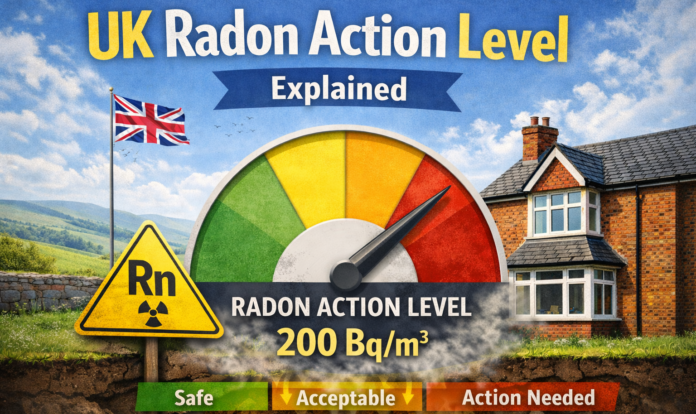
The UK Radon Action Level is 200 becquerels per cubic metre of air, written as 200 Bq/m³.
According to UKHSA’s Action Level and Target Level page, radon levels in homes should be reduced where the annual average concentration is more than 200 Bq/m³. That recommendation has been endorsed by the Government.
That is the official starting point. If your measured annual average radon level is above 200 Bq/m³, UK guidance says the level should be reduced.
For most homeowners, that means the Action Level is the main number that answers the question: “At what point does UKHSA say I should actually do something about radon in my home?”
What the Action Level actually means
The Action Level is not just a number on a chart. It is a decision point.
In practical terms, it means that when a properly measured home shows an annual average radon concentration above 200 Bq/m³, UKHSA recommends remedial action to reduce the level. It is the point at which a radon problem becomes something the homeowner is expected to address rather than simply note.
That said, the Action Level is not the same thing as a perfect line between safe and dangerous. Radon risk does not suddenly begin at 200 Bq/m³, and it does not vanish at 199 Bq/m³. The Action Level is better understood as the point where the UK public-health system says the level is high enough that reduction is recommended.
This is why the UK framework also uses a second number, the Target Level, which helps homeowners avoid treating 200 as a false “everything below this is fine” line.
Why it is based on an annual average
One of the most important parts of the Action Level is that it applies to the annual average concentration in a home.
That detail matters because radon changes over time. It varies by weather, season, airflow, pressure differences, and how a building is used. A result from one cold week, one warm spell, or one short snapshot does not tell the whole story.
UKHSA explains this clearly on its Measuring Radon page. Domestic measurements are normally carried out with two detectors, one in a bedroom and one in a living area, over three months. The purpose is to average out short-term fluctuations and estimate the exposure people actually experience in the rooms they use most.
That means the Action Level is not designed for casual spot checks or random one-day readings. It is designed to be used with the UK’s standard homeowner measurement method, which tries to reflect longer-term living conditions.
For homeowners, the simplest version is this: the Action Level is meant to be compared with a proper UK-style radon measurement, not a quick guess.
Action Level vs. Target Level
This is where many homeowners get confused, because UK radon guidance uses two different numbers.
The Action Level is 200 Bq/m³. This is the point where UKHSA says radon levels in homes should be reduced.
The Target Level is 100 Bq/m³. UKHSA says this is the ideal outcome for remedial work in existing homes and for protective measures in new buildings.
That means the two numbers are not competing standards. They do different jobs.
The Action Level tells you when reduction is officially recommended.
The Target Level tells you what the ideal outcome looks like once radon reduction is being considered or carried out.
UKHSA also says that if a result lies between the Target and Action Levels, reduction should still be considered, especially if there is a smoker or ex-smoker in the home. That is an extremely important point because it shows the UK system is not just “under 200 equals done, over 200 equals problem.” It is more nuanced than that.
In short, the Action Level is the main intervention threshold. The Target Level is the ideal destination.
How to read your radon result against the Action Level
Once you understand the two-level system, reading a radon result becomes much easier.
The first question is whether your result is below 100, between 100 and 199, or at or above 200.
Those three bands line up naturally with the way UKHSA frames the issue. Below 100 is below both the Target and Action Levels. Between 100 and 199 is below the Action Level but above the Target Level. At or above 200 is above the Action Level.
That does not replace professional advice or remedial guidance, but it does give homeowners a clear mental model for what the number means.
What results below 100 Bq/m³ mean
If your radon result is below 100 Bq/m³, it is below both the Target Level and the Action Level.
For most homeowners, that is reassuring. It means the home is already below the level UKHSA describes as the ideal outcome for remedial works and new-building protective measures.
That does not mean radon is zero. It does not mean the home never needs to be thought about again, especially if substantial building work changes how the ground floor or lower levels behave. But in practical homeowner terms, a result below 100 Bq/m³ is where most people will feel comfortably within the UK guidance framework.
What results between 100 and 199 Bq/m³ mean
This range is one of the most misunderstood parts of UK radon guidance.
A result between 100 and 199 Bq/m³ is below the Action Level, so UKHSA is not saying the home is above the formal intervention threshold. But it is also above the Target Level, which means the result is not at the ideal outcome either.
UKHSA says that action to reduce radon should be considered in this range, especially if there is a smoker or ex-smoker in the home. That is because smoking and radon together significantly increase lung-cancer risk.
For homeowners, this range is best understood as not officially high enough to trigger the Action Level, but high enough to take seriously. It is a zone where some people will decide to monitor, some will choose to reduce the level, and some will act more quickly if there are additional risk factors such as smoking or heavy use of a basement.
So no, a result of 150 Bq/m³ is not the same as a result of 230 Bq/m³. But it is also not the same as a result of 20 Bq/m³.
What results at or above 200 Bq/m³ mean
This is the point where the UK framework becomes very clear.
If the annual average concentration is at or above 200 Bq/m³, the result is at or above the UK Radon Action Level. UKHSA says radon levels should be reduced in homes at this point.
For homeowners, that means the question shifts from “Should I worry about this?” to “How do I reduce it?”
This is the practical purpose of the Action Level. It turns radon from a background possibility into a specific problem that should be addressed.
That does not mean panic. Radon is a long-term risk, not an immediate emergency like a fire or gas leak. But it does mean the result should not be ignored or indefinitely postponed.
What very high results mean
Not all above-Action-Level results feel the same in practical terms.
A result just over 200 Bq/m³ and a result far above that level are both above the Action Level, but they may not create the same sense of urgency. UKHSA’s radon reduction page notes that if levels exceed 1000 Bq/m³, householders may wish to contact UKHSA for advice.
That does not mean lower above-threshold levels are unimportant. It simply shows that very high readings may justify especially direct guidance or prioritisation.
For ordinary homeowner decision-making, the safest approach is still simple: once you are above the Action Level, treat the result as something that should be reduced. The higher the result, the less sense it makes to delay.
How the Action Level relates to radon Affected Areas
The Action Level is also part of how the UK identifies radon Affected Areas.
UKHSA’s example radon address-search report explains that a radon Affected Area is defined as an area where the radon level in at least one property in every hundred is estimated to exceed the Action Level. That means the Action Level is not only a homeowner benchmark. It is also built into how the country maps and classifies radon risk geographically.
This is why the Action Level appears in two different parts of the UK radon system. It matters for your individual measurement result, and it also matters for the probability model used to identify affected areas.
The map and address-search tools are therefore not separate from the Action Level. They are built around it.
That is also why UKHSA’s map language uses probabilities such as less than one in 100 in white areas and greater than one in 3 in the darkest areas. Those probabilities are about the chance of a building exceeding the Action Level.
Why basements are treated differently
Basements are one of the most important exceptions in the UK radon system.
UKHSA says all occupied basements should be monitored regardless of mapped radon potential. Its address-search materials also say basement and cellar areas are considered to be at additional risk from high radon levels.
This matters because some homeowners assume that if the map shows low radon probability for their area, a basement does not need special attention. UKHSA’s guidance says otherwise.
The logic is practical. Basements and cellars sit closer to the ground, where radon enters from the soil, and they often have ventilation and pressure conditions that can allow higher levels to accumulate. So the Action Level still matters there, but the route to deciding whether to test is more cautious than it is for ordinary above-ground rooms.
For homeowners, the takeaway is simple: if you have a regularly used basement or cellar, do not rely only on the broad map colour. Treat that space as worth direct measurement.
How the Action Level affects new-builds and building work
The Action Level does not just affect existing homes. It also shapes building regulations and new-home practice.
UKHSA’s building-regulations guidance says that in higher-radon areas, the regulations may require either no protective measures, basic protective measures, or full protective measures depending on the probability of buildings having high radon levels.
That means the Action Level plays a role behind the scenes in deciding where protection is needed in new construction and extensions.
UKradon’s house-sales guidance also says that when you move into a new-build home in a radon Affected Area, a three-month radon test should be carried out during the first year of occupation because it is not guaranteed that the radon level will be below the Action Level. That is a very useful point for buyers. A radon-protected new-build is not the same thing as a home that has already been proven to sit below the Action Level.
So the Action Level is not just something you use after a test. It also helps shape the preventive side of UK radon policy.
How it affects house sales
The Action Level also matters during house sales.
UKradon’s house-sales guidance says buyers in radon Affected Areas should ask whether the sellers have already carried out a three-month radon test and request the report if they have. If the property has not been tested, buyers may wish to discuss a retention with their solicitor in case the result later comes back above the Action Level and remedial work is needed.
That means the Action Level is part of conveyancing risk, not just post-purchase health guidance. It is the benchmark that helps determine whether a buyer may be inheriting a radon reduction problem.
For sellers, the same number matters because a property already known to be above the Action Level may raise obvious questions about whether remedial work has been completed and whether the result has been verified afterwards.
What landlords should know
Landlords should not assume the Action Level is only for owner-occupiers.
UKradon’s landlord guidance says radon is identified as a potential hazard in dwellings under the Housing Act 2004, and that where the Housing Health and Safety Rating System score exceeds certain trigger points, the local authority is obliged to act.
In practical terms, that means the Action Level can affect rental housing decisions and responsibilities too. If a rented property in a radon Affected Area has not been considered at all, that is not just a technical oversight. It can become a housing safety issue.
For private landlords and buy-to-let owners, the Action Level is therefore relevant both from a duty-of-care point of view and from a broader compliance perspective.
Common mistakes homeowners make
Thinking the Action Level is the same as a guarantee of safety below it.
It is not. The UK framework also uses a Target Level of 100 Bq/m³, which shows that lower is still better.
Thinking a result of 199 Bq/m³ means “nothing to think about.”
Not quite. It is below the Action Level, but still above the Target Level, and UKHSA says reduction should be considered in that band, especially if smoking is involved.
Thinking the Action Level applies to any quick reading.
It does not. It refers to the annual average concentration in a home, which is why UKHSA uses the three-month, two-detector measurement method.
Thinking the map alone decides everything.
Maps indicate probability of exceeding the Action Level. They do not replace testing of an individual home.
Thinking basements follow the same simple map logic as other rooms.
They do not. Occupied basements should be monitored regardless of mapped radon potential.
Thinking a new-build home automatically sits below the Action Level forever.
It may not. UKradon says new-build homes in affected areas should still be tested during the first year of occupation.
Bottom line for homeowners
The UK Radon Action Level is 200 Bq/m³. It is the point at which UKHSA says radon levels in homes should be reduced.
But the smarter way to understand it is this: the Action Level is the main intervention threshold, not the whole radon story. It sits above the UK Target Level of 100 Bq/m³, which represents the ideal outcome. That means results below 200 are not all equal, and results above 200 should not be ignored.
If you want to use the Action Level properly, follow the UK system that goes with it. Check whether your property is in a radon Affected Area, test the home correctly using the standard three-month method, interpret the result as an annual average, and take remedial action if the level is at or above 200 Bq/m³.
That is what the Action Level is really for. It gives homeowners a clear answer to the question: At what point does radon become something I should actively reduce in my home?
Sources
- UKradon: Radon Action Level and Target Level
- UKradon: Measuring Radon
- UKradon: UK Maps of Radon
- UKradon: Radon Searches
- UKradon: How to Reduce Radon Levels
- UKradon: Radon and Building Regulations
- UKradon: Radon and House Sales
- UKradon: Landlord’s Responsibilities with Regard to Radon
- HSE: Radon in the Workplace