
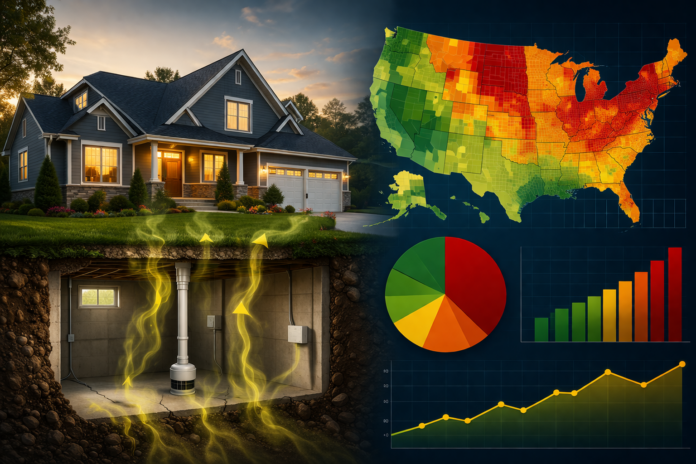
Radon Statistics: The Numbers Every Homeowner Should Know
Radon is one of those home health issues that many people have heard about but do not fully understand. The danger is real, but the statistics can feel abstract unless they are explained in simple terms. This guide breaks down the most important radon statistics in plain English so you can quickly understand how common radon is, why it matters, and what the numbers actually mean for your home and family.
Unless otherwise noted, the statistics below are U.S. figures drawn from the Environmental Protection Agency (EPA), the Centers for Disease Control and Prevention (CDC), the National Institute of Environmental Health Sciences (NIEHS), and National Radon Program Services. The goal here is not to overwhelm you with data. It is to give you the clearest, most useful radon numbers in one place.
Table of Contents
- Quick Radon Statistics at a Glance
- How Common Is Radon in Homes?
- How Dangerous Is Radon?
- How Smoking Changes the Risk
- What Radon Levels Are Common?
- Radon Statistics in Schools
- What These Statistics Mean for Homeowners
- Bottom Line
- Sources
Quick Radon Statistics at a Glance
If you only remember a handful of radon numbers, these are the ones that matter most.
| Statistic | What It Means |
|---|---|
| About 21,000 deaths per year | EPA estimates radon causes about 21,000 lung cancer deaths in the United States each year. |
| Second leading cause of lung cancer | Radon is second only to smoking as a cause of lung cancer overall. |
| Number one cause among people who never smoked | Radon is the leading cause of lung cancer among non-smokers. |
| About 1 in 15 homes | EPA estimates that roughly 1 in 15 U.S. homes has a radon level at or above 4 pCi/L. |
| 4 pCi/L | This is EPA’s recommended action level for fixing a home. |
| 2 to 4 pCi/L | EPA also recommends considering mitigation in this range. |
| 1.3 pCi/L | This is the average indoor radon level in U.S. homes. |
| 0.4 pCi/L | This is the average outdoor radon level. |
| Nearly 1 in 5 schools | EPA estimates nearly 20% of schools have at least one schoolroom above 4 pCi/L. |
| More than 70,000 schoolrooms | EPA estimates over 70,000 schoolrooms in use today have high short-term radon levels. |
How Common Is Radon in Homes?
The statistic most people hear first is this: about 1 in 15 homes in the United States is estimated to have a radon level at or above 4 picocuries per liter of air (pCi/L). That means elevated radon is not a rare edge case. Nationally, it is common enough that every homeowner should take it seriously.
That number is also only a national average. Some areas are much lower. Some are much higher. In other words, the 1 in 15 figure is useful, but it should not be treated as a guarantee for any specific neighborhood, zip code, or house.
This is especially important because high radon levels have been found in every state. EPA also notes that homes with elevated radon have been found in all three radon zones, including areas labeled as lower potential. A zone map can be helpful for understanding regional patterns, but it cannot tell you whether your particular home is safe.
That is why the biggest takeaway from radon statistics is not just that radon is common. It is that statistics cannot predict your exact house. Two homes on the same street can have very different radon levels because of soil conditions, foundation details, air pressure differences, cracks, sump openings, crawl spaces, and how the house is used.
Recent EPA messaging adds another useful point of context: tens of millions of homes in the United States have already been tested, and millions of homes with high radon levels have been fixed. That tells us two things. First, the problem is widespread enough that millions of homes needed action. Second, radon problems are fixable, and homeowners have been addressing them for years.
How Dangerous Is Radon?
The health statistics are the reason radon matters.
EPA and CDC say radon is the second leading cause of lung cancer in the United States, behind cigarette smoking. EPA estimates radon is responsible for about 21,000 lung cancer deaths every year. For a home-related environmental hazard that has no smell, no color, and no immediate symptoms, that is a strikingly large number.
Another statistic that often surprises people is this: radon is the number one cause of lung cancer among people who have never smoked. EPA estimates that about 2,900 of the annual radon-related lung cancer deaths occur among people who never smoked.
That matters because many homeowners assume radon is only a major issue for smokers. Smoking absolutely increases the danger, and we will cover that next, but radon is still a meaningful health risk even for people with no history of smoking.
NIEHS adds an important piece of context here as well. Most radon exposure happens indoors, especially in homes, schools, and workplaces. This is why radon is not just a geology issue or a construction issue. It is a long-term indoor air quality issue.
CDC also notes that lung cancer from radon does not usually announce itself early. People generally do not experience warning symptoms from the radon exposure itself. The damage happens slowly over time, which is one reason testing matters so much. You cannot use your senses or your day-to-day health to judge whether your home has a radon problem.
How Smoking Changes the Risk
Smoking and radon are a dangerous combination.
CDC states that people who smoke and are exposed to radon have a 10 times greater risk of developing lung cancer from radon exposure compared with people who do not smoke and are exposed to the same radon levels. That is one of the most important radon statistics in the entire conversation.
EPA’s lifetime risk charts make this difference easier to picture. At a radon level of 4 pCi/L, which is EPA’s action level:
| Lifetime Exposure at 4 pCi/L | Estimated Lung Cancer Risk |
|---|---|
| If 1,000 people who smoke are exposed over a lifetime | About 62 could get lung cancer |
| If 1,000 people who never smoked are exposed over a lifetime | About 7 could get lung cancer |
Even the national average indoor level of 1.3 pCi/L is not meaningless in the EPA risk chart:
| Lifetime Exposure at 1.3 pCi/L | Estimated Lung Cancer Risk |
|---|---|
| If 1,000 people who smoke are exposed over a lifetime | About 20 could get lung cancer |
| If 1,000 people who never smoked are exposed over a lifetime | About 2 could get lung cancer |
These are not meant to scare people. They are meant to clarify the stakes. Radon risk is real for everyone, but the combination of smoking and radon is where the danger becomes especially severe.
CDC also points out that lung cancer is not limited only to people who smoke. In a broader context, the agency notes that 10% to 20% of lung cancers each year occur in people who never smoked or smoked fewer than 100 cigarettes in their lifetime. That is one reason radon gets so much attention in public health discussions. As smoking rates decline, other causes of lung cancer become more visible.
What Radon Levels Are Common?
To understand radon statistics, it helps to know what the numbers mean.
Radon is measured in pCi/L, short for picocuries per liter of air. You do not need to be a radiation expert to use this measurement. For homeowners, the important part is knowing how EPA interprets the results.
| Radon Level | What It Means |
|---|---|
| 0.4 pCi/L | Average outdoor level |
| 1.3 pCi/L | Average indoor level in U.S. homes |
| 2.0 to 4.0 pCi/L | EPA says you should consider fixing the home |
| 4.0 pCi/L or higher | EPA recommends taking action to reduce radon |
A lot of people assume that anything below 4.0 pCi/L is “safe.” That is not really the right way to think about it. EPA says there is no known safe level of radon exposure. The 4.0 pCi/L number is a practical action threshold, not a line where risk suddenly begins.
EPA also says homeowners should consider fixing radon levels between 2.0 and 4.0 pCi/L. That is an important statistic because it reminds people that radon risk is not all-or-nothing.
Another useful data point from CDC is that radon levels are often higher in basements and lower levels of homes and buildings. That does not mean upper floors are irrelevant, but it does explain why testing is usually focused on the lowest lived-in level of the home.
Radon Statistics in Schools
Homeowners are often surprised to learn that radon is also a school issue, not just a house issue.
EPA estimates that nearly 1 in 5 schools has at least one schoolroom with a short-term radon level above 4 pCi/L. EPA also estimates that more than 70,000 schoolrooms currently in use have high short-term radon levels.
Those are significant numbers. Children and school staff spend large amounts of time inside school buildings over many years. So while most radon discussions are centered on homes, the data shows that schools deserve attention too.
The good news is that the lesson is the same as it is for homes: testing matters, and mitigation works. A school does not have to guess, and a family does not have to guess about their home either.
What These Statistics Mean for Homeowners
Numbers are only useful if they help people make better decisions. Here is what the statistics above actually mean in practical terms.
First, every home has some radon. Radon is present outdoors and indoors. The question is not whether radon exists. The question is whether it is building up inside your home at a level that raises long-term health risk.
Second, you should not rely on assumptions. A newer home can have radon. An older home can have radon. A home without a basement can have radon. A house in a lower radon zone can still test high. Statistics are useful for understanding the scale of the issue, but they cannot replace an actual test.
Third, testing is the only way to know your level. That point shows up again and again across EPA, CDC, and National Radon Program Services materials. Radon has no smell, no taste, and no color. If your home has never been tested, you are operating on guesswork.
Fourth, results should lead to action. If your home tests at 4 pCi/L or higher, EPA recommends mitigation. If your result is between 2 and 4 pCi/L, EPA says you should consider fixing it. And after mitigation, CDC says you should test again to confirm the system is working and consider retesting every two years.
Fifth, certain situations make testing even more important. CDC specifically highlights testing when preparing to buy or sell a home, before and after renovations, and when a lower level of the home will start being used more often, such as turning a basement into a bedroom, office, or playroom.
When you step back and look at the statistics as a whole, the message is pretty straightforward. Radon is common. Radon is dangerous. Radon is easy to miss without testing. And radon problems can usually be reduced with proven mitigation methods.
Bottom Line
The most important radon statistic is not just that it causes about 21,000 lung cancer deaths each year. It is that so much of this risk is preventable.
Radon has been found in every state. About 1 in 15 homes is estimated to be at or above EPA’s action level. Nearly 1 in 5 schools has at least one schoolroom above that same threshold. People who smoke face dramatically higher risk, but radon is also the leading cause of lung cancer among people who never smoked.
If there is one simple takeaway from all of these statistics, it is this: test your home instead of guessing. That is the only way to know whether the numbers apply to your house.
Sources
- U.S. Environmental Protection Agency (EPA) – Health Risk of Radon
- Centers for Disease Control and Prevention (CDC) – Radon and Your Health
- CDC – Radon and Your Health Feature
- CDC – Reducing Radon Levels in Your Home
- EPA – What Is the Average Level of Radon Found in Homes in the U.S.?
- EPA – What Is EPA’s Action Level for Radon and What Does It Mean?
- EPA – Radon in Schools
- EPA – EPA Map of Radon Zones
- EPA – Prevent Lung Cancer by Testing Your Home for Radon
- National Institute of Environmental Health Sciences (NIEHS) – Indoor Air Quality
- National Radon Program Services – Main Page