Radon Professionals: What They Do, How to Choose One, and What Homeowners Should Expect
If your radon test comes back elevated, or you’re buying/selling a home and need reliable radon results, you will eventually run into the “radon professional” world. That can mean a certified tester, a mitigation contractor, or (in some cases) a company that does both. The right professional can reduce radon quickly and verify results. The wrong professional can waste money, create poor aesthetics, or leave you with a system that underperforms. This guide explains what radon pros do, the credentials that matter, what to ask before hiring, and how to confirm that the job was actually done correctly. (Source: EPA – https://www.epa.gov/radon)
Throughout this article, we focus on widely accepted guidance from the EPA and on major credentialing bodies and professional organizations that exist specifically to improve consistency and quality in radon testing and mitigation. (Source: NRPP – https://nrpp.info/; Source: NRSB – https://nrsb.org/; Source: AARST – https://aarst.org/)
Table of Contents
- What “radon professional” means
- The two main roles: measurement vs mitigation
- When you should hire a radon pro (vs DIY)
- Credentials that matter: NRPP, NRSB, and standards
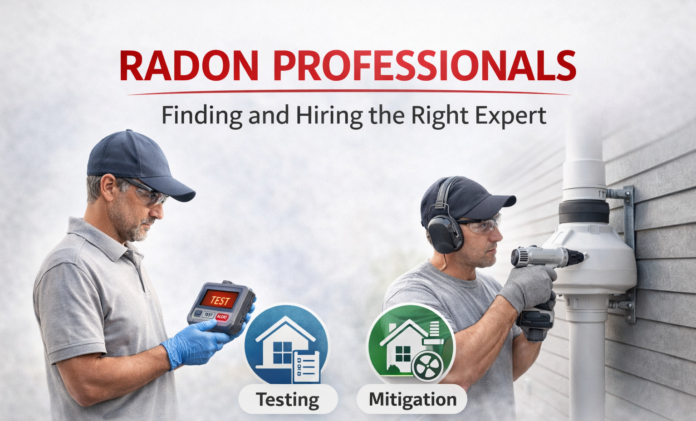
- What a radon measurement professional does
- What a radon mitigation professional does
- What to look for before hiring (checklist)
- Questions to ask during estimates
- Red flags and common scams
- What “good work” looks like: verification and documentation
- Real estate radon pros: special considerations
- After the job: maintenance, retesting, and long-term confidence
- FAQs about radon pros
- Sources and further reading
1) What “radon professional” means
A “radon professional” generally refers to someone who provides radon services such as testing (measurement) and/or mitigation (radon reduction). In practice, you’ll usually see these split into two categories:
- Radon measurement professionals: perform radon tests following recognized protocols and provide results.
- Radon mitigation professionals: design and install systems that reduce radon levels, then verify performance.
Some companies do both, and in some regions that’s common. But it’s helpful to understand the distinction because the skills and equipment for accurate testing can differ from the skills and equipment required for effective mitigation. (Source: EPA – https://www.epa.gov/radon)
Radon has no smell and causes no immediate symptoms, so quality control is extremely important. A professional is valuable when you need: (1) reliable measurement under recognized conditions, (2) a mitigation system designed for your specific foundation type, and (3) confirmation that the final radon levels are meaningfully reduced. (Source: EPA Citizen’s Guide (PDF) – https://www.epa.gov/sites/default/files/2016-12/documents/2016_a_citizens_guide_to_radon.pdf; Source: EPA Consumer’s Guide to Radon Reduction (PDF) – https://www.epa.gov/sites/default/files/2016-12/documents/2016_consumers_guide_to_radon_reduction.pdf)
2) The two main roles: measurement vs mitigation
Radon measurement (testing)
Testing is the only way to know your radon level. Measurement professionals help ensure that testing follows appropriate placement rules and test conditions, especially for short-term real estate tests. EPA emphasizes that you cannot “guess” radon levels, and that testing should be done correctly to be meaningful. (Source: EPA – https://www.epa.gov/radon)
Radon mitigation (reduction)
Mitigation professionals reduce radon by installing systems that prevent soil gas from entering the home (or capture and vent it). EPA’s mitigation guidance explains common methods like sub-slab depressurization and stresses that post-mitigation testing is essential. (Source: EPA Consumer’s Guide (PDF) – https://www.epa.gov/sites/default/files/2016-12/documents/2016_consumers_guide_to_radon_reduction.pdf)
Important concept: testing tells you the problem exists; mitigation changes the building so the problem is reduced; retesting proves the change worked. (Source: EPA Citizen’s Guide (PDF) – https://www.epa.gov/sites/default/files/2016-12/documents/2016_a_citizens_guide_to_radon.pdf)
3) When you should hire a radon pro (vs DIY)
Many homeowners can start with DIY testing. A properly placed and properly performed test kit can give a reliable baseline. But there are situations where hiring a pro is usually worth it:
- Real estate transactions: timeline pressure + the need for protocol consistency.
- Unusually high results: you want quick confirmation and a plan.
- Complex foundations: crawlspaces, multiple slabs, walkout basements, mixed construction.
- Conflicting test results: you need a more controlled approach.
- Mitigation planning: you want a designed solution, not guesses.
EPA provides guidance on testing types and emphasizes proper placement and conditions, which is exactly where professionals can add value. (Source: EPA Citizen’s Guide (PDF) – https://www.epa.gov/sites/default/files/2016-12/documents/2016_a_citizens_guide_to_radon.pdf; Source: EPA home buying guidance (PDF) – https://www.epa.gov/system/files/documents/2024-11/2024-buying-a-new-home-how-to-protect-your-family-from-radon_0.pdf)
Simple rule: If you’re just screening your home and you’re comfortable following instructions, DIY is fine. If the result is high, the situation is time-sensitive, or the building is complex, professional help often pays for itself in reliability and fewer mistakes. (Source: EPA – https://www.epa.gov/radon)
4) Credentials that matter: NRPP, NRSB, and standards
Radon is a niche trade, which is why specialized credentialing exists. Two of the most widely recognized credentialing organizations in the U.S. are:
- NRPP (National Radon Proficiency Program) (Source: NRPP – https://nrpp.info/)
- NRSB (National Radon Safety Board) (Source: NRSB – https://nrsb.org/)
These organizations maintain directories of credentialed professionals. In many areas, state radon programs reference these credentials, and some states require licensing or specific certifications to perform certain radon services. (Source: EPA radon overview – https://www.epa.gov/radon)
What about standards (ANSI/AARST, ASTM)?
Professional practice is often guided by consensus standards (for example, ANSI/AARST standards for radon measurement and mitigation). AARST (American Association of Radon Scientists and Technologists) is a major professional organization in this space and is closely tied to training and standards. (Source: AARST – https://aarst.org/)
ASTM publishes various environmental testing standards as well. These are typically more technical and often used in professional and institutional contexts. (Source: ASTM – https://www.astm.org/)
Homeowner takeaway: You don’t need to memorize standards numbers. What you want is a pro who can clearly explain their process, follows recognized protocols, and is willing to verify results with post-work testing. Credentials and standards are proxies for that professionalism. (Source: EPA Consumer’s Guide (PDF) – https://www.epa.gov/sites/default/files/2016-12/documents/2016_consumers_guide_to_radon_reduction.pdf)
5) What a radon measurement professional does
A measurement pro’s job is to deliver a radon result you can trust. That means controlling the variables that can distort radon readings—especially for short-term tests.
Key responsibilities
- Confirm test location: lowest lived-in level (or transaction-specific guidance)
- Proper device placement: away from drafts, windows, doors, vents, and high humidity
- Follow test protocol: including closed-house conditions when required
- Use appropriate devices: including continuous radon monitors where needed
- Document conditions: start/end time, device serial number, location description
EPA provides guidance on where to place tests and emphasizes that short-term tests can be influenced by ventilation and home conditions. This is why protocols exist, especially during real estate transactions. (Source: EPA Citizen’s Guide (PDF) – https://www.epa.gov/sites/default/files/2016-12/documents/2016_a_citizens_guide_to_radon.pdf; Source: EPA home buying guidance (PDF) – https://www.epa.gov/system/files/documents/2024-11/2024-buying-a-new-home-how-to-protect-your-family-from-radon_0.pdf)
Why “closed-house conditions” matter
Closed-house conditions are used to prevent someone from artificially lowering radon during a short-term test by opening windows and ventilating heavily. EPA discusses closed-house conditions and home-buying testing guidance for radon. (Source: EPA home buying guidance (PDF) – https://www.epa.gov/system/files/documents/2024-11/2024-buying-a-new-home-how-to-protect-your-family-from-radon_0.pdf)
6) What a radon mitigation professional does
A mitigation pro’s job is to reduce radon reliably and safely, with a system appropriate for your foundation type, then verify the reduction.
The most common method: sub-slab depressurization
EPA describes sub-slab depressurization as the most common radon reduction technique in many homes. It uses a vent pipe and fan to draw radon from beneath the slab and vent it outdoors. (Source: EPA Consumer’s Guide (PDF) – https://www.epa.gov/sites/default/files/2016-12/documents/2016_consumers_guide_to_radon_reduction.pdf)
Crawlspaces
Crawlspaces may use a sealed membrane (liner) with suction beneath it (sub-membrane depressurization). The goal is the same: control soil gas before it enters the home. (Source: EPA Consumer’s Guide (PDF) – https://www.epa.gov/sites/default/files/2016-12/documents/2016_consumers_guide_to_radon_reduction.pdf)
Post-mitigation testing
EPA emphasizes that you should test after installing a radon reduction system to confirm it lowered radon levels. A professional should always discuss verification testing as part of the scope. (Source: EPA Consumer’s Guide (PDF) – https://www.epa.gov/sites/default/files/2016-12/documents/2016_consumers_guide_to_radon_reduction.pdf)
7) What to look for before hiring (checklist)
This section is the homeowner “shortlist.” If you do nothing else, use this checklist to filter professionals.
Measurement pro checklist
- Uses appropriate device(s) and can explain why (short-term kit vs continuous monitor)
- Explains placement rules and confirms test location
- Follows closed-house conditions (when applicable)
- Provides a clear report: start/end time, location, result, and next-step guidance
- Is credentialed (NRPP/NRSB) or meets your state’s licensing requirements
Mitigation pro checklist
- Explains your foundation type and proposed method (slab, basement, crawlspace)
- Shows where the pipe, fan, and discharge will go (aesthetics matter)
- Includes a system monitor (e.g., manometer) so you can verify operation
- Discusses sealing as a supporting step where appropriate (sump lids, cracks)
- Commits to post-mitigation testing (and tells you when to do it)
- Provides warranty/guarantee terms in writing
- Is credentialed (NRPP/NRSB) or meets your state’s licensing requirements
EPA’s radon reduction guidance covers common methods and emphasizes retesting to confirm results, which should be standard practice for any mitigation contractor. (Source: EPA Consumer’s Guide (PDF) – https://www.epa.gov/sites/default/files/2016-12/documents/2016_consumers_guide_to_radon_reduction.pdf)
8) Questions to ask during estimates
Radon work is not a commodity. The “same” system can be installed in sloppy or excellent ways. These questions force clarity:
Questions for testers
- What testing method will you use, and why?
- Where will the device be placed and how will you document it?
- What conditions do you require during the test (closed-house conditions)?
- What happens if the result is near the EPA action level—do you recommend follow-up testing?
Questions for mitigators
- What mitigation method are you recommending (SSD, sub-membrane, etc.) and why?
- How many suction points do you expect, and what would cause you to add another?
- Where will the fan be located (attic, garage, exterior), and how noisy is it?
- Where will the exhaust discharge terminate (roofline, etc.)?
- Will you install a manometer or other indicator so I can confirm the system is working?
- When should I do a post-mitigation test, and what result do you typically aim for?
- What warranty do you provide for the fan and workmanship?
EPA’s consumer mitigation guide is a useful reference for what systems look like, what methods are common, and why post-mitigation testing matters. (Source: EPA Consumer’s Guide (PDF) – https://www.epa.gov/sites/default/files/2016-12/documents/2016_consumers_guide_to_radon_reduction.pdf)
9) Red flags and common scams
Most radon pros are legitimate, but homeowners should still watch for patterns that signal low-quality or predatory behavior:
- No post-mitigation testing: If they don’t talk about verification, that’s a major red flag.
- “Sealing is all you need” claims: Sealing helps but often isn’t sufficient by itself. (Source: EPA Consumer’s Guide (PDF) – https://www.epa.gov/sites/default/files/2016-12/documents/2016_consumers_guide_to_radon_reduction.pdf)
- No explanation of method: A good pro can explain why they chose a method for your foundation.
- Weird vent discharge plans: Venting design matters; discharge location should be thoughtful and safe.
- Pressure sales tactics: “Sign today or else” is a bad sign—radon is serious, but you should still be allowed to compare bids.
- No credentials and no state licensing: If your state requires licensing/certification, that’s non-negotiable.
10) What “good work” looks like: verification and documentation
Quality radon work is verifiable. That’s what makes it different from many vague “indoor air” services. Whether you hired a tester or a mitigator, you should expect documentation.
For testing
- Device type and identifier
- Exact placement location and level (lowest lived-in level, etc.)
- Start and end date/time
- Any relevant conditions noted (closed-house conditions, weather notes if included)
- Final result and next-step guidance (confirmatory testing vs mitigation)
For mitigation
- Method used (SSD, sub-membrane, etc.)
- Where suction point(s) were created
- Fan model/location and discharge route
- System monitor installed (manometer) and what “normal” looks like
- Post-mitigation testing recommendation and timing
EPA explicitly emphasizes that you should test after a mitigation system is installed to confirm radon levels were reduced. (Source: EPA Consumer’s Guide (PDF) – https://www.epa.gov/sites/default/files/2016-12/documents/2016_consumers_guide_to_radon_reduction.pdf)
11) Real estate radon pros: special considerations
Real estate radon testing is its own world because of time constraints and negotiation stakes. Short-term tests are common, and closed-house conditions are often required to avoid artificially low results. EPA provides a home-buying radon guidance document that explains testing and protection strategies. (Source: EPA home buying guidance (PDF) – https://www.epa.gov/system/files/documents/2024-11/2024-buying-a-new-home-how-to-protect-your-family-from-radon_0.pdf)
Common mistake: People treat a real estate radon test as “the final truth” about the house forever. In reality, radon varies over time. If you buy a home, it’s still wise to test again later under your living conditions, or perform a long-term test for your own confidence. (Source: EPA Citizen’s Guide (PDF) – https://www.epa.gov/sites/default/files/2016-12/documents/2016_a_citizens_guide_to_radon.pdf)
12) After the job: maintenance, retesting, and long-term confidence
A radon system is a risk-control system. Like any risk-control, you periodically verify it still works. EPA provides guidance on retesting and encourages retesting after home changes and over time. (Source: EPA retesting guidance – https://www.epa.gov/radon/how-often-should-i-testretest-my-home-radon)
What homeowners should do long-term
- After mitigation: test to confirm reduction
- After renovations: retest, especially after basement finishing or HVAC changes
- Periodically: retest every few years (or per local program recommendations)
- Monitor system operation: check manometer/indicator periodically
Remember: mitigation doesn’t “remove radon from the planet.” It changes the house so radon is less likely to accumulate indoors. Testing is how you confirm that protection stays in place. (Source: EPA – https://www.epa.gov/radon)
13) FAQs about radon pros
Do I need a radon pro to test my home?
Not always. Many people start with a DIY kit. But a pro can be valuable for real estate tests, complicated buildings, or when results are high and you want reliable confirmation quickly. EPA provides decision guidance and emphasizes proper testing conditions. (Source: EPA Citizen’s Guide (PDF) – https://www.epa.gov/sites/default/files/2016-12/documents/2016_a_citizens_guide_to_radon.pdf)
How do I find a certified radon contractor?
You can search credentialed professionals through NRPP or NRSB directories, and many state radon programs provide guidance on local contacts. (Source: NRPP – https://nrpp.info/; Source: NRSB – https://nrsb.org/; Source: EPA – https://www.epa.gov/radon)
Should the same company test and mitigate?
It can be fine, but be aware of conflicts of interest in any industry: a company that profits from mitigation might be incentivized to interpret marginal results aggressively. The best protection is to use recognized testing protocols and, when in doubt, confirm with a follow-up test (especially long-term) before committing to major work. (Source: EPA Citizen’s Guide (PDF) – https://www.epa.gov/sites/default/files/2016-12/documents/2016_a_citizens_guide_to_radon.pdf)
Will mitigation always get me below 2.0 pCi/L?
Many homes can be reduced to low levels, often below 2.0 pCi/L, but outcomes depend on the home’s design and the system installed. EPA notes that radon can be reduced in most homes with today’s technology and emphasizes post-mitigation testing to confirm results. (Source: EPA Consumer’s Guide (PDF) – https://www.epa.gov/sites/default/files/2016-12/documents/2016_consumers_guide_to_radon_reduction.pdf)
Sources and further reading
- EPA – Radon hub: https://www.epa.gov/radon
- EPA – A Citizen’s Guide to Radon (PDF): https://www.epa.gov/sites/default/files/2016-12/documents/2016_a_citizens_guide_to_radon.pdf
- EPA – Consumer’s Guide to Radon Reduction (PDF): https://www.epa.gov/sites/default/files/2016-12/documents/2016_consumers_guide_to_radon_reduction.pdf
- EPA – Buying a new home (radon guidance) (PDF): https://www.epa.gov/system/files/documents/2024-11/2024-buying-a-new-home-how-to-protect-your-family-from-radon_0.pdf
- EPA – How often to test/retest: https://www.epa.gov/radon/how-often-should-i-testretest-my-home-radon
- NRPP – Certified professionals: https://nrpp.info/
- NRSB – Certified professionals: https://nrsb.org/
- AARST – Standards and professional org: https://aarst.org/
- ASTM: https://www.astm.org/
Bottom line
Radon professionals exist because radon is invisible and because quality matters. The best pros follow recognized protocols, explain their work clearly, and verify outcomes with testing. Use credentials (NRPP/NRSB) as a filter, ask direct questions, avoid red flags, and always verify results—especially after mitigation. (Source: EPA – https://www.epa.gov/radon)