
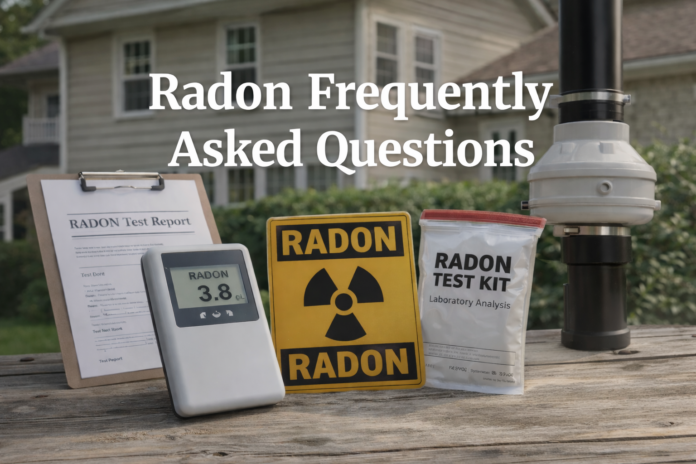
Radon is one of those home hazards that feels strange at first because it’s invisible, odorless, and naturally occurring. That “invisible” part is exactly why radon generates so many questions: Where does it come from? How do I know if I have it? What number is “bad”? What do I do if my test comes back high?
This page is built as a true FAQ resource: a curated list of common questions, each with a paragraph-style answer. If you remember only one thing, remember this: testing is the only way to know your home’s radon level. (Source: EPA – https://www.epa.gov/radon)
Table of Contents
- What is radon?
- Why is radon dangerous?
- How common is radon in homes?
- What is the EPA “action level” for radon?
- What does pCi/L mean?
- How many lung cancer deaths are linked to radon each year?
- Is radon really the #1 cause of lung cancer in non-smokers?
- Does smoking make radon risk worse?
- What are the symptoms of radon exposure?
- How does radon get into a home?
- Is radon only a basement problem?
- Can new homes have radon?
- If my neighbor’s radon is low, does that mean mine is low?
- Do radon maps tell me whether my home is safe?
- What’s the difference between a short-term and long-term radon test?
- Which type of radon test should I use?
- When is the best time of year to test for radon?
- What are “closed-house conditions” and why do they matter?
- Where should I place a radon test kit?
- If my radon test comes back at 4.0 pCi/L or higher, what should I do?
- What if my radon level is between 2.0 and 4.0 pCi/L?
- How does radon mitigation work?
- Can mitigation really reduce radon to safe levels?
- How much does a radon mitigation system cost?
- How long does it take to install mitigation?
- Should I retest after mitigation?
- If I have a mitigation system, can radon come back?
- Do air purifiers remove radon?
- Can I fix radon myself by sealing cracks?
- What is radon-resistant new construction (RRNC)?
- What’s the difference between passive and active radon systems?
- Is radon in drinking water a concern?
- Should I test air first or water first?
- Do granite countertops cause dangerous radon?
- Can radon be a problem in apartments or upper floors?
- Should schools and workplaces test for radon?
- Does opening windows reduce radon?
- Is there a “safe” radon level?
- How do U.S. recommendations compare to international guidelines?
- Can radon affect pets?
1) What is radon?
Radon is a radioactive gas that forms naturally as uranium breaks down in soil, rock, and sometimes water. Outdoors it disperses quickly and is usually not a concern, but indoors it can accumulate—especially in lower levels like basements and crawlspaces. Radon’s main health risk comes from inhaling it over time; it can damage lung tissue and increase the risk of lung cancer. (Source: CDC – https://www.cdc.gov/radon/about/index.html)
2) Why is radon dangerous?
Radon gas itself isn’t what “burns” the lungs—it’s what radon turns into as it decays. Radon breaks down into radioactive particles that can be inhaled and lodge in the lining of your lungs, where they emit radiation and can damage cells over years of exposure. This is why radon is strongly linked with lung cancer risk. (Source: American Cancer Society – https://www.cancer.org/cancer/risk-prevention/radiation-exposure/radon.html)
3) How common is radon in homes?
Radon is found across the U.S. because uranium exists naturally in varying amounts in soil and rock. That means any home can have radon—even neighboring homes can test very differently due to foundation differences, soil pathways, ventilation patterns, and pressure dynamics. The practical takeaway is simple: you can’t “guess” radon risk based on appearances; you test. (Source: EPA – https://www.epa.gov/radon)
4) What is the EPA “action level” for radon?
The U.S. Environmental Protection Agency recommends fixing (mitigating) a home when radon levels are 4.0 pCi/L (picocuries per liter) or higher. Importantly, EPA also states there is no known safe level of radon exposure, and encourages homeowners to consider reducing levels between 2.0 and 4.0 pCi/L as well. (Source: EPA – https://www.epa.gov/radon/what-epas-action-level-radon-and-what-does-it-mean)
5) What does pCi/L mean?
pCi/L stands for picocuries per liter, which is the standard unit used in the U.S. to describe how much radioactivity from radon is present in a liter of air. Many other countries use Bq/m³ (becquerels per cubic meter). EPA notes that 4.0 pCi/L ≈ 150 Bq/m³, and 2.0 pCi/L ≈ 75 Bq/m³. (Source: EPA – https://www.epa.gov/radon/what-epas-action-level-radon-and-what-does-it-mean)
6) How many lung cancer deaths are linked to radon each year?
Multiple public health organizations cite EPA estimates that radon is responsible for about 21,000 lung cancer deaths each year in the United States. That number is an estimate (not a perfect “count”), but it’s widely referenced because it highlights radon as a major environmental carcinogen. (Source: CDC – https://www.cdc.gov/radon/features/reduce-radon.html)
7) Is radon really the #1 cause of lung cancer in non-smokers?
Yes—radon is widely recognized as a leading cause of lung cancer among people who have never smoked. While smoking remains the overall #1 cause of lung cancer, radon is typically described as the #2 overall cause and the leading environmental cause, and it is especially significant for never-smokers. (Source: American Lung Association – https://www.lung.org/blog/radon-smoking-synergy)
8) Does smoking make radon risk worse?
Very much so. The combined exposure to radon and cigarette smoke is more dangerous than either exposure alone. Public health guidance emphasizes that smokers exposed to radon have much higher lung cancer risk compared with non-smokers exposed to the same radon level. If you smoke, radon mitigation is still important—but quitting smoking is the biggest single way to reduce lung cancer risk. (Source: CDC – https://www.cdc.gov/radon/features/reduce-radon.html)
9) What are the symptoms of radon exposure?
Radon exposure usually causes no immediate symptoms. That’s part of what makes it so deceptive. The harm is typically long-term and relates primarily to lung cancer risk after years of exposure. If someone develops lung cancer, symptoms can include persistent cough, coughing up blood, chest pain, hoarseness, or shortness of breath—but these are not “radon symptoms” specifically. The correct approach is prevention via testing and mitigation. (Source: American Cancer Society – https://www.cancer.org/cancer/risk-prevention/radiation-exposure/radon.html)
10) How does radon get into a home?
Radon typically moves from the soil into a home through openings and pathways in the lowest level of the structure—cracks, gaps around pipes, sump pits, construction joints, block walls, floor drains, and similar entry points. Many homes create a slight vacuum effect that pulls soil gas inward as warm air rises and exits the home (pressure-driven flow). (Source: EPA – https://www.epa.gov/sites/default/files/2014-08/documents/buildradonout.pdf)
11) Is radon only a basement problem?
Basements are often where radon is highest because they are closest to the soil and often have more entry points. But radon can affect any level of a home—especially if air movement or HVAC patterns distribute it upward. If you spend time on the lowest level (finished basement, home gym, bedroom, office), that’s the level you should prioritize for testing and decision-making. (Source: EPA – https://www.epa.gov/radon/how-often-should-i-testretest-my-home-radon)
12) Can new homes have radon?
Yes—new construction can have radon just like older homes. A home’s age doesn’t determine radon levels; what matters is soil gas, pathways into the structure, and pressure/ventilation dynamics. This is why EPA promotes radon-resistant new construction (RRNC) techniques, especially in areas with higher radon potential. (Source: EPA – https://www.epa.gov/radon/radon-resistant-construction-basics-and-techniques)
13) If my neighbor’s radon is low, does that mean mine is low?
Not necessarily. Homes right next to each other can have very different radon levels due to differences in foundation type, cracks, sump pits, HVAC operation, and how the home interacts with soil pressure. The only reliable way to know your home’s radon level is to test your home. (Source: EPA – https://www.epa.gov/radon)
14) Do radon maps tell me whether my home is safe?
Radon maps can show regional potential, but EPA is explicit: the map should not be used to determine whether an individual home needs testing. Testing is recommended no matter where you live because local conditions and house-specific factors dominate. (Source: EPA – https://www.epa.gov/radon/epa-map-radon-zones-and-supplemental-information)
15) What’s the difference between a short-term and long-term radon test?
A short-term test typically stays in place for 2–7 days, giving a snapshot of radon levels during that period. A long-term test is generally 90 days to a year and is more likely to reflect the home’s true annual average because radon varies day-to-day and season-to-season. Long-term results are usually better for making a confident decision. (Source: EPA – https://www.epa.gov/sites/default/files/2016-12/documents/2016_a_citizens_guide_to_radon.pdf)
16) Which type of radon test should I use?
If you want the best representation of your year-round average, a long-term test is ideal. If you need quick information (for example, during a real estate purchase), a short-term test can be used—often followed by a second short-term test or a long-term test depending on results. EPA describes common long-term devices like alpha track detectors and electret ion chambers. (Source: EPA – https://www.epa.gov/system/files/documents/2024-11/2024-buying-a-new-home-how-to-protect-your-family-from-radon_0.pdf)
17) When is the best time of year to test for radon?
You can test any time, but radon levels often run higher when homes are “closed up” (for example, during colder months) because ventilation is reduced and stack effect can increase soil gas entry. The key is not to overthink timing: test under normal living conditions and follow the kit instructions, especially around closed-house conditions for short-term tests. (Source: EPA – https://www.epa.gov/system/files/documents/2024-11/2024-buying-a-new-home-how-to-protect-your-family-from-radon_0.pdf)
18) What are “closed-house conditions” and why do they matter?
For many short-term tests, especially in real estate contexts, EPA recommends maintaining closed-house conditions for at least 12 hours before the test begins and during the test period (with normal entry/exit allowed). The purpose is to prevent unusual ventilation (open windows/doors) from artificially lowering results and masking a real radon issue. (Source: EPA – https://www.epa.gov/system/files/documents/2024-11/2024-buying-a-new-home-how-to-protect-your-family-from-radon_0.pdf)
19) Where should I place a radon test kit?
In general, place the test on the lowest lived-in level of the home (or the level you spend time in), away from drafts, high heat, exterior doors/windows, and high-humidity areas like bathrooms and laundry rooms (unless instructions say otherwise). The goal is a representative reading of normal breathing air in that level—not a reading influenced by an air vent or an open window. (Source: EPA – https://www.epa.gov/sites/default/files/2016-12/documents/2016_a_citizens_guide_to_radon.pdf)
20) If my radon test comes back at 4.0 pCi/L or higher, what should I do?
EPA recommends fixing the home if a long-term test is 4.0 pCi/L or higher, or if the average of two short-term tests is 4.0 pCi/L or higher. Mitigation is a proven, established home improvement: the purpose is to reduce radon levels and therefore reduce long-term lung cancer risk. (Source: EPA – https://www.epa.gov/sites/default/files/2016-12/documents/2016_consumers_guide_to_radon_reduction.pdf)
21) What if my radon level is between 2.0 and 4.0 pCi/L?
EPA notes there is no known safe level of radon exposure and encourages homeowners to consider reducing radon levels in the 2.0–4.0 pCi/L range as well—particularly if you spend a lot of time on the lowest level or if someone in the home is at higher risk (for example, smokers). Many systems can reduce radon below 2.0 pCi/L. (Source: EPA – https://www.epa.gov/radon/what-epas-action-level-radon-and-what-does-it-mean)
22) How does radon mitigation work?
The most common method is soil suction / sub-slab depressurization, which uses a vent pipe and fan to pull radon-laden soil gas from beneath the foundation and safely vent it above the roofline before it can enter the home. Other approaches exist for crawlspaces and certain foundations, but the overall principle is the same: redirect the radon pathway away from indoor breathing air. (Source: EPA – https://www.epa.gov/sites/default/files/2016-12/documents/2016_consumers_guide_to_radon_reduction.pdf)
23) Can mitigation really reduce radon to safe levels?
In most homes, yes. EPA states that with today’s technology, radon levels in most homes can be reduced to 2 pCi/L or below. That doesn’t mean every house is identical, but it does mean mitigation is usually very effective when designed and installed properly. (Source: EPA – https://www.epa.gov/sites/default/files/2016-12/documents/2016_consumers_guide_to_radon_reduction.pdf)
24) How much does a radon mitigation system cost?
Costs vary by home design and region, but EPA’s radon construction guidance commonly cites that retrofitting an existing home typically costs about $800 to $2,500, while including radon-resistant features in new construction can be much less expensive. In practice, your best next step is to get quotes from qualified mitigators and ask what method they recommend for your foundation type. (Source: EPA – https://www.epa.gov/sites/default/files/2014-08/documents/buildradonout.pdf)
25) How long does it take to install mitigation?
Many mitigation systems can be installed relatively quickly—often within a day—though complex foundations or routing needs can add time. What matters most is the quality of the design (proper suction point, pipe routing, fan placement, sealing where appropriate) and the follow-up test that confirms results. (Source: CDC – https://www.cdc.gov/radon/prevention/index.html)
26) Should I retest after mitigation?
Absolutely. A post-mitigation test confirms that the system actually reduced radon as intended. After that, EPA recommends retesting again in the future—especially if living patterns change (like beginning to use a basement more often) or after major renovations that could affect ventilation or pressure dynamics. (Source: EPA – https://www.epa.gov/radon/how-often-should-i-testretest-my-home-radon)
27) If I have a mitigation system, can radon come back?
Radon levels can change over time due to fan performance, home renovations, foundation changes, or shifts in how the house is heated/ventilated. Mitigation systems also have components that can fail (fans don’t last forever). That’s why periodic retesting is wise even after you’ve “solved” radon once. (Source: EPA – https://www.epa.gov/radon/how-often-should-i-testretest-my-home-radon)
28) Do air purifiers remove radon?
Typical air purifiers are not a reliable radon solution. Radon is a gas, and while some filtration systems can reduce certain particles, the core radon problem is entry from the soil and accumulation indoors. Mitigation focuses on controlling the source and pressure-driven entry—not filtering the air after the fact. The right tool is a radon reduction system designed for the home. (Source: EPA – https://www.epa.gov/sites/default/files/2016-12/documents/2016_consumers_guide_to_radon_reduction.pdf)
29) Can I fix radon myself by sealing cracks?
Sealing can be helpful as part of a broader strategy, but EPA generally describes sealing as supportive, not a stand-alone solution, because radon can still enter through many pathways and pressure differences can still draw soil gas in. Most reliable reductions come from active systems (like sub-slab depressurization) that change how soil gas moves. (Source: EPA – https://www.epa.gov/sites/default/files/2014-08/documents/buildradonout.pdf)
30) What is radon-resistant new construction (RRNC)?
Radon-resistant new construction is a set of building techniques used during construction to make a home more resistant to radon entry and easier to mitigate if needed. It commonly involves features like a gas-permeable layer beneath the slab, plastic sheeting, sealing/caulking, vent piping that routes soil gas upward, and an electrical junction box to add a fan later if required. (Source: EPA – https://www.epa.gov/radon/radon-resistant-construction-basics-and-techniques)
31) What’s the difference between passive and active radon systems?
A passive radon system typically relies on natural air movement through installed vent piping (no fan). An active system adds a fan to create consistent suction and improve performance. Many new homes are built “radon-ready” with passive features, and if testing shows elevated levels, they can often be upgraded to active by adding a fan. (Source: EPA – https://www.epa.gov/radon/radon-resistant-construction-basics-and-techniques)
32) Is radon in drinking water a concern?
It can be—especially for private wells. EPA notes that radon can be present in water, and some radon can be released into indoor air when water is used for showering, washing dishes, and other household uses. Generally, the inhalation risk from radon released into the air is considered larger than the risk from swallowing radon in water, but water testing can matter in well-based homes. (Source: EPA (archived) – https://archive.epa.gov/water/archive/web/html/basicinformation-2.html; Source: EPA – https://www.epa.gov/radtown/radtown-radon-teacher-information)
33) Should I test air first or water first?
Many programs recommend testing indoor air first, because air radon is the primary driver of risk, and because water radon often matters most when it contributes meaningfully to indoor air levels. If your indoor air is elevated and you have a private well, then testing water can help determine whether water is contributing. (Source: EPA (archived) – https://archive.epa.gov/water/archive/web/html/basicinformation-2.html)
34) Do granite countertops cause dangerous radon?
Granite (and other natural stone) can emit small amounts of radiation and radon, but EPA states the levels attributable to granite countertops are not typically high, and that the principal source of radon in homes is usually the soil in contact with basement floors and walls. If you’re concerned, the practical move is still the same: test your indoor air. (Source: EPA – https://www.epa.gov/radon/what-about-radon-and-radioactivity-granite-countertops)
35) Can radon be a problem in apartments or upper floors?
Yes, though the most common driver is still radon entry from the ground. Apartments on lower levels (garden units, first-floor units over basements, units above crawlspaces) can have a higher likelihood of elevated readings. Upper floors can still show radon depending on how the building is constructed and how air moves through it. If you live in a multi-unit building, ask management about testing and mitigation policies. (Source: EPA – https://www.epa.gov/radon)
36) Should schools and workplaces test for radon?
EPA recommends that schools nationwide be tested for radon, and notes that testing is relatively simple and guidance is available. Because children and staff spend many hours inside school buildings, school testing programs are a meaningful public health step—especially in areas with known radon potential. (Source: EPA – https://www.epa.gov/radon/radon-schools)
37) Does opening windows reduce radon?
Opening windows can temporarily lower radon by increasing ventilation, but it’s not a dependable long-term solution—especially during seasons when you can’t reasonably keep windows open. Also, “ventilate away the problem” doesn’t address the underlying pressure-driven entry from soil gas. If your levels are elevated, mitigation is the durable fix. (Source: EPA – https://www.epa.gov/sites/default/files/2016-12/documents/2016_consumers_guide_to_radon_reduction.pdf)
38) Is there a “safe” radon level?
EPA emphasizes that there is no known safe level of radon exposure. The action level of 4.0 pCi/L is a risk-management threshold—meaning it marks a point where remediation is strongly recommended because the risk is materially higher and mitigation is practical. Many homeowners still choose to reduce radon below 2.0 pCi/L when feasible. (Source: EPA – https://www.epa.gov/radon/what-epas-action-level-radon-and-what-does-it-mean)
39) How do U.S. recommendations compare to international guidelines?
The World Health Organization (WHO) recommends establishing a national reference level of 100 Bq/m³ where possible, and that reference levels generally should not exceed 300 Bq/m³. The U.S. EPA action level of 4.0 pCi/L is roughly 150 Bq/m³, which sits between those WHO values. Different countries set different thresholds based on policy, feasibility, and national risk programs. (Source: WHO – https://www.who.int/news-room/fact-sheets/detail/radon-and-health)
40) Can radon affect pets?
There is growing discussion about radon exposure and pets because pets often spend more time close to the floor and may have different breathing patterns. Some public health materials note that, like children, pets can receive a higher dose relative to body size in certain situations. While the strongest evidence base is for human lung cancer risk, reducing radon is a reasonable step for the whole household—humans included. (Source: North Carolina DHHS – https://www.ncdhhs.gov/radon-effects-pets-factsheet/open)
Final takeaway
Radon is not something you “solve” with a guess. You solve it with a test, and if needed, a mitigation system that changes how soil gas interacts with your home. If you’ve never tested, the best day to do it is today—because radon risk is completely invisible until you measure it. (Source: EPA – https://www.epa.gov/radon)