
What Is Radon?
Radon is an invisible, odorless, radioactive gas that forms naturally in the ground. You can’t see it, smell it, or taste it, which is why it often goes unnoticed. The problem is that radon can build up indoors to levels that increase the risk of lung cancer over time. In other words, radon is not something you “notice” in a home. It is something you measure.
The U.S. Environmental Protection Agency (EPA) describes radon as a major health concern because it is a leading cause of lung cancer in the United States. The EPA notes that radon is the number one cause of lung cancer among non-smokers and the second leading cause overall (Source: EPA). The EPA also estimates radon is responsible for about 21,000 lung cancer deaths each year, including roughly 2,900 deaths among people who have never smoked (Source: EPA).
Radon isn’t “rare,” and it isn’t limited to older homes or a few high-risk states. Radon has been found in homes across every region of the country. The difference is that some houses have conditions that allow radon to enter more easily and concentrate indoors. That is why two homes on the same street can have very different readings, even if they were built around the same time and look similar from the outside.
Where Radon Comes From
Radon is produced by the natural radioactive decay of uranium in soil and rock. Uranium breaks down over time into other elements, including radium. Radium then decays into radon gas. This process has been happening since the Earth formed, and it will continue for an extremely long time. Radon is not something we can “eliminate” from the environment. What we can do is keep it from accumulating inside the places where people live and work.
Radon is a gas, which means it can move through tiny spaces in soil. Outdoors, radon becomes diluted in open air and usually does not pose the same kind of risk as it can indoors. The challenge begins when radon rises from the ground and enters enclosed structures, where it can build up to elevated levels.
How Radon Gets Into Homes
A useful way to think about radon is to picture your home sitting on top of soil that is constantly releasing small amounts of gas. Homes are not airtight, and the area where the house meets the ground typically has many small openings. Radon takes advantage of those openings.
Pressure differences are a major driver of radon entry. Warm air in a home rises and escapes through upper levels and attic spaces. That upward movement can create slightly lower pressure in the lower parts of the building, such as basements and crawl spaces. When indoor pressure is lower than soil pressure, the home can “draw” soil gases in. Radon is part of those soil gases, along with moisture and other naturally occurring gases.
The CDC notes that radon can enter homes through cracks in solid floors, construction joints, gaps around service pipes, and cavities inside walls, among other pathways (Source:
CDC). The key point is that radon entry is not a sign that a home was “built wrong.” Even newer, well-constructed homes can have elevated radon.
It’s also worth mentioning that homes designed to be energy efficient can sometimes trap indoor air more effectively. Reduced natural air exchange can allow radon levels to build higher than they might in a draftier structure. Energy efficiency is a good thing, but it makes testing and mitigation even more important because it can increase the chance that indoor radon stays indoors.
Where Radon Levels Are Usually Highest
Radon levels are often highest on the lowest level of a building because that level is closest to the source. In many homes, that means basements or crawl spaces. But homes without basements are not “safe by default.” Radon can also enter slab-on-grade homes and accumulate indoors. The practical rule is the one used by public health agencies: test the lowest level that is regularly used.
Radon levels can also change over time. Weather, seasonal temperature shifts, HVAC operation, how often windows are opened, and changes to the building envelope can all affect a home’s reading. It’s common for levels to be higher in winter, when windows are closed and homes are heated, but that doesn’t mean summer levels are automatically “fine.” This natural fluctuation is one reason long-term testing is often recommended for homeowners who want a more reliable average.
How Radon Is Measured (and What “4 pCi/L” Means)
Radon is measured in picocuries per liter of air (pCi/L). This unit describes the amount of radioactivity in the air you’re breathing. If you’ve never dealt with radiation units before, don’t worry about the physics. What matters is how your number compares to health-based guidance.
The EPA’s action level is 4.0 pCi/L. If a home tests at or above 4.0 pCi/L, the EPA recommends taking steps to reduce the level (Source: EPA). The EPA also emphasizes that there is no known safe level of radon exposure, and that even levels below 4.0 pCi/L carry some risk (Source: EPA (Citizen’s Guide to Radon)). That may feel frustrating, but it’s actually a useful way to think about risk: lower is better, and mitigation is a straightforward way to reduce that risk when levels are elevated.
For context, the EPA reports that the average indoor radon concentration in U.S. homes is about 1.3 pCi/L and the average outdoor level is about 0.4 pCi/L (Source: EPA). Those averages are not “targets,” but they provide perspective. Many homes are below the national indoor average. Many are above it. Testing is how you move from guesswork to a real number.
How Common Is Radon?
Radon is common enough that the EPA’s messaging is blunt: everyone should test. One of the most-cited national estimates comes from EPA reporting that suggests about one in fifteen homes in a key “should test” category would have a radon level of 4 pCi/L or more (Source: EPA (Report on the Environment Indicator)). The point is not that exactly 1-in-15 homes will test high in your neighborhood. The point is that elevated radon is common enough, and unpredictable enough, that it is rational to treat testing as a standard part of home ownership.
Radon potential maps can be helpful as a general guide, but they do not replace testing. A “lower potential” area can still have high readings in a specific home due to soil conditions, foundation details, or how the house exchanges air with the outdoors. Conversely, a home in a “high potential” area can still test low. Maps describe the region,
not your foundation.
Why Radon Is Dangerous (Radon’s Link to Lung Cancer)
Radon is dangerous primarily because of what happens after you breathe it. Radon decays into radioactive particlesthat can lodge in the lungs. As these particles continue to decay, they release radiation that can damage lung tissue over time. That damage can contribute to the development of lung cancer.
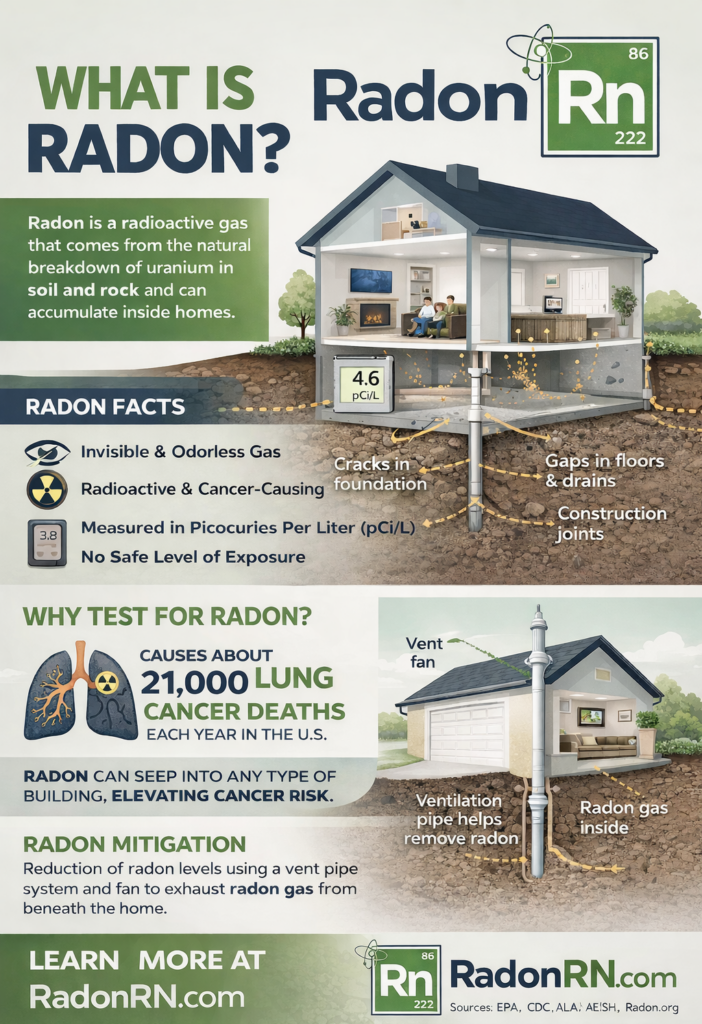
The EPA estimates radon is responsible for about 21,000 lung cancer deaths per year (Source: EPA). The CDC echoes this estimate and emphasizes that radon is the second leading cause of lung cancer after cigarette smoking (Source: CDC). These are not small numbers. They’re the reason radon is treated as a public health priority rather than a niche
home inspection concern.
Smoking dramatically increases radon risk. The CDC states that people who smoke and are exposed to radon have a risk roughly ten times greater than people who do not smoke at the same radon levels (Source: CDC). This is sometimes described as a synergy: radon and smoking together are far more dangerous than either factor alone. Even if you don’t smoke, radon remains a serious risk. But if you do smoke, reducing radon becomes even more urgent.
Understanding “Risk” Without Getting Lost in the Numbers
People often want a simple answer: “If my home is at 4.1 pCi/L, am I doomed?” That’s not how risk works. Radon risk is dose-dependent, which means it increases with both concentration and time. The longer you breathe elevated radon, the more exposure accumulates. This is also why you can’t interpret a single short snapshot as the complete story for a home you plan to live in for many years.
The EPA provides radon risk estimates for smokers and non-smokers at different radon levels (Source: EPA). These charts are helpful because they show two things clearly. First, higher radon levels correspond to higher lung cancer risk. Second, smokers face dramatically higher risk at the same radon level. You don’t need to memorize the
numbers to use the chart effectively. The practical takeaway is that lowering radon lowers risk, and that action is recommended at 4.0 pCi/L because the risk is high enough that mitigation is strongly justified.
How to Test for Radon
Testing is the only way to know a home’s radon level. There is no visual clue that reliably indicates radon is high. A home can look dry, clean, new, and well-maintained, and still have an elevated reading. Another home can have visible cracks and still test low. Radon is about physics and geology, not appearances.
In general, radon tests fall into two categories: short-term and long-term. Short-term tests are commonly used when someone needs a quick result, such as during a real estate transaction. Long-term tests measure across a longer period, which helps smooth out daily and seasonal fluctuations and gives a better estimate of a home’s annual
average. The CDC notes that there is no known safe level of radon and that the EPA recommends taking action to reduce radon levels in the range of 2 to 4 pCi/L as well, especially if you can do so (Source: CDC).
Proper test placement matters. Tests should be placed on the lowest lived-in level of the home, away from drafts, exterior doors, windows, and high-humidity areas like direct shower steam. The goal is to measure the air people actually breathe under normal living conditions. If you’re testing for a home purchase, follow the test instructions
closely and consider using a qualified professional who understands closed-house conditions and chain-of-custody requirements where applicable.
What Happens If Your Radon Level Is High?
If you test at or above 4.0 pCi/L, don’t panic. Elevated radon is common, and it is typically fixable. The EPA and U.S. Surgeon General recommend reducing radon levels at or above 4 pCi/L (Source: EPA). In many cases, mitigation is a one-time installation followed by simple ongoing operation and periodic retesting.
The most common and widely used radon mitigation approach in basement and slab-on-grade houses is sub-slab depressurization. At a high level, this method prevents radon from entering the home by changing the pressure under the foundation. A typical system uses one or more pipes connected to a fan to draw soil gases from beneath the slab
and vent them safely above the roofline before they can leak into indoor air. The EPA describes sub-slab depressurization as a common and effective strategy that exhausts sub-slab gases before they move through floor cracks or openings (Source: EPA).
How effective is mitigation? The EPA’s consumer guidance is clear: radon reduction systems work. Some systems can reduce radon levels by up to 99 percent (Source: EPA (Consumer’s Guide to Radon Reduction)). That doesn’t mean every home will get a 99% reduction, because every structure is different. But it does mean that mitigation is not experimental. It is a mature, proven approach used in millions of homes.
After mitigation, retesting is essential. A mitigation system should be verified with a follow-up radon test to confirm the level has been reduced. The EPA explicitly notes that buildings with very high radon levels can be reduced to acceptable levels with proper reduction systems and that the home should be tested again after it is fixed (Source: EPA). Retesting is also a smart periodic habit even after successful mitigation, especially after major renovations, HVAC changes, or foundation work.
Radon in Water (A Smaller, But Real, Consideration)
When people hear “radon,” they usually think about indoor air. That’s correct: indoor air is the main risk pathway for most homes. However, radon can also be present in well water in some areas. When water that contains radon is used for showering, washing dishes, or laundry, some of that radon can be released into the air you breathe.
EPA materials on radon in drinking water note that only a small portion of radon in indoor air comes from drinking water, and that inhalation risk from radon released into indoor air is generally the bigger concern compared with ingesting radon in water (Source: EPA (Radon in Drinking Water Q&A PDF)). For most homeowners, the practical approach is to test indoor air first. If your home uses a private well and you have reason to suspect water contribution, water testing can be a useful additional step, especially when indoor air
levels remain elevated despite mitigation or when a well is known to be in a radon-prone region.
Radon-Resistant New Construction (Building It In From Day One)
Many people assume radon is an “old house problem.” It isn’t. New homes can test high as well, sometimes because tighter construction reduces natural ventilation. The good news is that radon-resistant construction techniques can be incorporated during building, usually at a relatively low additional cost compared with retrofitting later.
The EPA outlines radon-resistant construction basics that focus on creating a gas-permeable layer beneath the slab, sealing and reducing soil gas entry points, and including venting pathways so radon can be routed safely outside (Source: EPA). The EPA also notes that new homes can be built to resist radon entry and that the additional cost at the time of construction is minimal, while reducing potential lung cancer risk when installed properly (Source: EPA).
Even when a home is built with radon-resistant features, testing still matters. A radon-resistant home is designed to reduce the likelihood of high levels, not to guarantee a specific measurement without verification. Think of it like a seatbelt: it improves safety, but you still check that it works and you still drive responsibly.
Radon and Real Estate: Why It Comes Up During Home Sales
Radon testing is common in real estate transactions because it’s one of the few indoor environmental hazards that can be measured quickly and corrected in a straightforward way. When a buyer requests a radon test, they’re usually not trying to “find fault.” They’re trying to reduce uncertainty. If a test comes back elevated, the most common outcome
is negotiation for mitigation or credit, followed by retesting to confirm the reduction.
From a homeowner’s perspective, a mitigation system is often a value-preserving improvement. It can remove a potential obstacle during resale, and it provides immediate health protection for current occupants. The most important mindset shift is to view radon mitigation like other home safety upgrades: it’s closer to installing smoke
detectors than it is to repairing catastrophic structural damage.
Common Misconceptions That Cause People to Skip Testing
Many homeowners skip radon testing because they believe one of a few common myths. One myth is that a brand-new home can’t have radon. In reality, the EPA’s guidance repeatedly emphasizes that any home can have radon, including new construction (Source: EPA (Citizen’s Guide to Radon)). Another myth is that a home without a basement is automatically safe. Radon can enter slab foundations and crawl spaces as well.
A third myth is that if a neighbor tested low, your home must be low too. Radon varies at the house level due to soil permeability, foundation details, and pressure dynamics. That’s why public health agencies don’t recommend “area guessing.” They recommend testing your specific home.
Finally, some people assume that if their radon level is “only a little high,” mitigation isn’t worth it. The EPA’s position is that there is no known safe radon level and that reducing exposure reduces risk (Source: EPA (Citizen’s Guide to Radon)). Once you view radon as a long-term exposure issue, the logic becomes clearer: lowering radon is a preventive action taken now to reduce risk later.
The Bottom Line
Radon is a naturally occurring radioactive gas produced by the decay of uranium in soil and rock. Outdoors, it usually disperses quickly. Indoors, it can accumulate to elevated levels, especially in lower areas of a home. The danger comes from long-term inhalation exposure, which increases the risk of lung cancer.
The EPA estimates radon causes about 21,000 lung cancer deaths per year and is the leading cause of lung cancer among non-smokers (Source: EPA). The EPA recommends taking action when a home tests at or above 4.0 pCi/L (Source: EPA). Testing is the only way to know your number, and mitigation is a proven, effective solution. Some mitigation systems can reduce radon levels by up to 99 percent (Source: EPA (Consumer’s Guide to Radon Reduction)).
At RadonRN.com, our goal is to be a clear, structured resource that helps you understand radon, measure it correctly, interpret your results, and take the right next step. If you take only one thing away from this article, make it this: radon is common, testing is simple, and fixing elevated levels is very achievable.